

The Forever Mitzvah
A short story
This is a short story I read at an event last week. I’ll relegate further throat-clearing to a footnote.1
The Forever Mitzvah
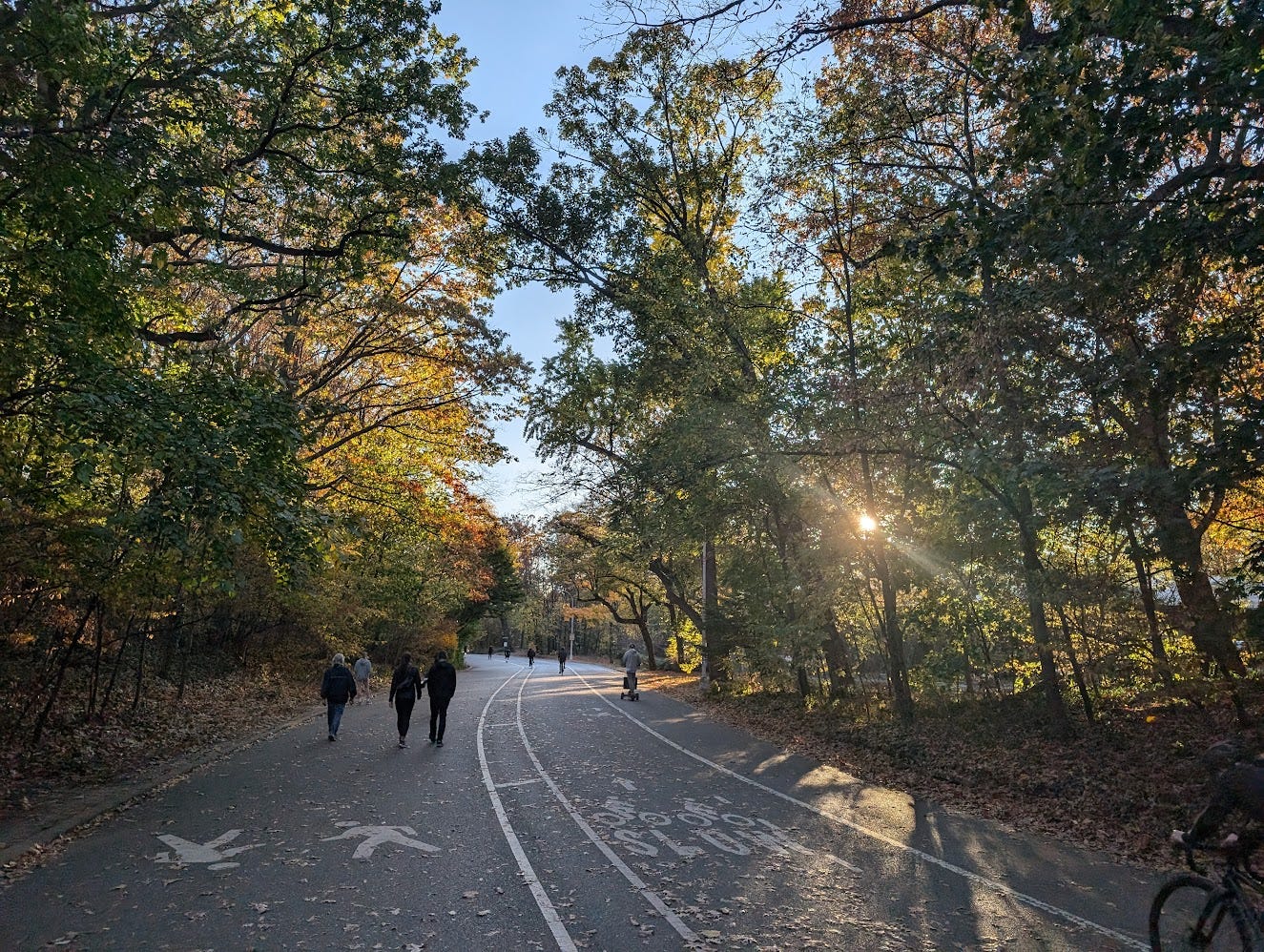
	In Prospect Park, as in many other parts of New York City, you’ll sometimes come across Jewish men seeking Jewish men. These men belong to a sect that believes that it’s a mitzvah, a good deed, to get less observant Jews to put on tefillin, which are black leather boxes containing parchment inscribed with verses from the Torah. You wear one on your arm and one on your head — I think the last time I did this was during my bar mitzvah. They’ll go up to possibly Jewish men and ask, “Are you Jewish?”
	Because I have a large, crooked nose, whenever I run in the park, these Jews home in on me like ducks chasing an anthropomorphic sack of bread crumbs. This triggers insecurities I thought I had conquered long ago. I’m otherwise over my nose. It was women I’d always been most concerned about, but over time I realized that some women — perverts — are into noses like mine, and others are willing to overlook it because I have developed so many other positive qualities, though I am precluded by space constraints from listing any of them here. Still, I don’t like thinking about my nose, and it’s hard to avoid doing so when the Jews of Prospect Park lock on to you like Yiddish-speaking Terminators.
	One of these Jews, though — he was different from all the others. He approached me a couple times on my runs this past fall, and I ignored him but I also noticed him. What stood out, at first, was that his body seemed like it should be biomechanically impossible. He was six-foot-eight, easily, a buck fifty soaking wet. I immediately found myself relating to him, simply because of my own feelings about my own dumb body. It was also noteworthy to me that he was rolling solo, unlike most of the other Jews-seeking-Jews, who tended to run in packs.
	Even though he came across like a poorly drawn cartoon character trapped in a horribly misguided crossover episode, nothing seemed to faze him. He asked and asked and asked random male strangers if they were Jewish and was always rejected but always maintained a broad smile. I could tell we were built quite differently. He was probably twenty years my junior, really just a kid, but he burrowed into my head a bit before I even knew his name.
	The third time he approached me, a sticky October evening, I could deny him no longer. I was just too damn curious. “Yeah, I’m Jewish,” I said. Then I just stood there. I hadn’t thought this through fully. “Nice to meet you, Jesse,” he said.
	Wait, what?
	“I’m Dovid. You can call me Dovi.” Things immediately became unbelievable. Unprompted, Dovi started rattling off deeply personal details about my recent life. 		“When your mom was diagnosed in 2020 you were dating a fellow atheist, a gentile,” he said. “You told her that you felt completely rudderless and like you had nothing to hang onto. Like you needed something to believe in.” I started to back away but found myself unable to disengage. “Then your mom died and you broke up with your girlfriend. Then you fell in love with a Mormon. That didn’t work out, partly because whenever she mentioned the obvious fact that God exists, you couldn’t hide your condescension. All these years later, would you say they’re any closer to that elusive rudder of yours?”
	I blinked a few times, immobilized. I couldn’t comprehend this sort of public, painful biographical loredump coming from a total stranger. “How the fuck do you know all this?” I asked, trying futilely to sound dangerous.
	“Just come with me,” said Dovi. He started walking and didn’t look back. The ploy worked; I couldn’t stay mad at Dovi. I fell in beside him and, unprompted, tried to explain what was going on: It wasn’t just all the recent breakups and death and senility and other losses piling up for my family, I explained. Living in a city was supposed to sustain and vivify you — that was why it was worth it — but lately it felt like there was a fine mesh sieve between everyone else and me, that whatever actually got through it was thin and watery and nutritionally worthless. Dovi nodded like he understood. He then proceeded to explain how it was that he knew so many intimate details about my life. It was a profoundly shocking and illuminating story.
	Anyway, 25 minutes later we were in Dovi’s small but extremely tidy room. His parents were elsewhere. I was sitting on the edge of his bed as he rummaged in a drawer. He found it, whatever it was. “Do you know what we do with a Torah when it’s too old and worn to be used anymore?” he asked, taking a seat next to me. I shrugged. Our thighs lightly touched and I tensed a little. “We dry them out in specialized chambers in water towers that we retrofit. When they get brittle enough we bring in old men. The old men say a few blessings, and then they shred the Torahs by hand while singing songs of praise and apology.”
	“They shred them?” I asked.
	“Yes,” Dovi said, handing me a small leather drawstring pouch. Sure enough, inside were shredded-up bits of Torah. From my long-ago Hebrew schooling I could make out an aleph here, a nun here, but for the most part there was no meaning left to extract, even if I could read Hebrew. I thought about the debate over whether black holes permanently destroy the information they consume, or whether, if you wait sufficiently many trillions of years, you can retrieve it.
	I fingered the pouch. “What do you do with it?” Dovi took it back from me, produced an old bronze menorah, and started to pack the shredded-up bits of Torah into the leftmost candleholder. He also produced a lighter.
	I’ve never done most drugs, especially this kind. The one time I was asked in high school, by an At The Drive-In roadie, to inject communion wafers dissolved in Jameson into my arm, I politely declined. When, at a party in my late 20s, I saw friends of friends of friends snorting pulverized bits of Quran off a glass living-room table after a conference in Doha, I fled for the kitchen, disgusted.
	Maybe that was why I was here — to stop being so afraid. Maybe Dovi, who had already so amazed and invigorated me, could reconfigure me into someone better and braver.
	So I sparked those holy-scroll remnants and inhaled as deeply as I could. I started to ask, through the smoke, how long to hold it in, but it was too late.
	I can’t really describe what it felt like. But imagine a void with an infinite array of Hebrew letters glowing, dancing, combining into new characters, spitting out offspring kept warm and alive by the residual warmth of the Big Bang — letters no other human has seen before containing meaning we won’t be able to decode until a million years from now, assuming we’re around that long, which we absolutely will not be, and which in turn are then attracted to one another, again creating yet newer letters, and on and on. Then imagine you somehow gather all those letters and stuff them into a shotgun shell and hold the shotgun under your chin and pull the trigger. That’s the closest I can get to describing the first five seconds of my first time smoking Torah.
	But now I was in the backseat of a taxi, my head against the window, as “Welcome To New Hampshire: Live Free Or Die” whizzed past. It was the summer of 1993. Dovi was driving, now wearing the rumpled secular clothes of your average Masshole taxi driver, including a backward Red Sox cap. His sidelocks bounced gently against the side of his head. His insane body barely fit in this car and I felt a surge of gratitude, the strongest I’d felt anything in awhile, that he’d joined me on this trip.
	We were headed to Water Country, a mediocre-at-best water park about an hour north of Boston. For decades, this water park has tortured parents by airing a devastatingly effective earworm on Nickelodeon and other sources of children’s entertainment. As a result, kids from Woonsocket to Bar Harbor and everywhere in between begged their parents to take them to Water Country, describing it in tones usually reserved for specialized cancer clinics.
	Dovi, staring straight ahead, began reciting it like a prayer. “When the sun is blazin’ and the summer gets hot,” he said. “Water Country’s a very cool spot.” He continued: “There’s no better place to feel and be young. Water Country. Have some fun.”
	As Dovi continued on to the second verse, I let his voice — much deeper and better than mine — fill the car. I let it fill me, fill everything. I imagined a universe consisting of just two people, Dovi and me, and just two places: Dovi’s room and Water Country. I imagined those two locations locked into a permanent stable orbit, nothing else, a two-body solution to the problem of infinity.
	I joined Dovi for the second and final chorus of the Water Country jingle. “Water Country,” we said in unison. “Have some fun.” After a beat Dovi added “Amen.” I felt so close to him I wanted to cry.
	Dovi coughed gently into the crook of his arm and then were waiting in line for Geronimo, the biggest waterslide Water Country had to offer. Dovi and I were at the base of a tower whose stairs zigzagged up to the slide’s entry point. The park was packed with every conceivable race of white New Englander, scrawny kids of every age, fat parents hopelessly trying to apply sunscreen and proscribe running and otherwise corral them.
	Geronimo was a rite of passage for boys in my community. The summer you were tall enough to ride it was always a big deal. There was an ironclad inverse relationship between how many summers it took you to muster the courage and how interesting a life you would lead. Scientists had proven this. The moment you splashed to a stop at the bottom that first time, that integer value altered your destiny. (Again, scientists really had proven this. MIT scientists.) The quicker you rode Geronimo, the quicker you were to hit important developmental milestones like having sex or smoking heinously bad weed out of a hollowed-out apple. My own history on this front was embarrassing but now the Torah shreddings seemed to be giving me another chance.
	Dovi, back in his Hasidic outfit despite its waterpark impracticality, smiled at me, at the slide, at everyone at the park. He then handed me a little Torah scroll and I unrolled it and he put a yarmulke on me and patted my head and I began reading. A few of the New Englanders pressed in to hear what I had to say. I translated it on the fly from Hebrew, because I now knew Hebrew.
	“The past is like a thick, chunky stew,” I read. “You’re born with a little bit of it in your belly. You’re fed more every day. But your body can’t digest it, so as you age and your immune system weakens, you’ll find yourself excreting it in increasingly unwelcome and physically and psychologically repulsive ways. You have no choice in this matter.”
	I rolled the scroll back up and handed it to Dovi. The crowd got back in line, more disappointed than angry, mumbling a bit. “ ‘Thick, chunky stew?’ ” I asked Dovi. “That’s the best we can do?”
	Dovi shrugged. “There are only so many original combinations of letters left,” he said.
	The worst-case outcome, Geronimo-wise, had always been you get to the top, you look down over the slide, and you panic. This would entail a humiliating and eternal-feeling walk of shame the wrong way back down, every dripping soul in that line clocking you as the loathsome coward you were.
	When we got to the top of the tower I saw that Water Country management had added a thoughtful second option. Across the platform from the entrance to the slide itself there was another gap in the railing, a quicker way down. Peering over, I saw a Water Country employee nonchalantly hosing chunks of humanity toward a drain. A small bulldozer idled nearby, the blonde teenage operator half-asleep and listening to a Walkman.
	“I’m not letting you go down that way,” said Dovi, pulling me back. “Let’s take the slide. I’ll go first.” The bolder kids always grabbed the bar atop the entrance to the slide and hurled themself outward; there were hierarchies nested within the hierarchies, and among those who braved Geronimo, only cowards butt-scooted tremulously over its event horizon. Dovi was no coward. He grasped the bar with both hands, looked back at me, and winked.
	“Wait!” I said. “Don’t go yet.”
	Dovi came up to me and wrapped me in a big hug. I started crying and looked up at him. He was the tallest man I had ever hugged and he smelled like chlorine and heavily buttered popcorn. It was nice. I felt cared for and understood. It didn’t even matter that Dovi couldn’t fix me, at least not yet. “Thank you,” I said, my voice muffled against his bony shoulder.
	“It’s what I’m here for,” said Dovi. He pulled back and kissed me squarely on the lips. It didn’t bother me at first — he’s from a different culture, I reminded myself — but when he tried to get his tongue in my mouth a current of atavistic rage surged through me and I pushed him away, hard. The trajectory was terrible. I rushed over just in time to see his backward ragdoll descent down Geronimo. He was breaking all the rules — you were supposed to lie perfectly flat and cross your arms and legs — and it was all my fault. As he approached the bottom of the slide, his head smashed viciously against it and he went still and I watched his body slide to a stop as awful crimson oozed behind him like slug slime. Dovi wasn’t moving and I immediately sprinted toward the other gap in the railing and heard the bulldozer rev up the moment I took flight.
	I awoke in Dovi’s bed to an older Jewish man, dressed the same as Dovi, holding a scalpel over my face. I jerked up, nearly nicking myself. He withdrew.
	“What the fuck?”
	Dovi looked up from his phone. “What the fuck what?”
	“Who is this guy and why is he about to cut my face?”
	“He’s not about to cut your face — he’s just taking measurements,” said Dovi, who seemed genuinely confused. “We’ve been through this.”
	It turned out the man’s name was Dr. Schwarzstern. Dovi had been recording my trip and he played the recording. It proved, beyond any semblance of a doubt, that while I was under the influence of Torah I had started screaming get this thing off me, get this thing off me, scratching at my nose. Dovi had asked if I was still under the influence and I had sworn I wasn’t — I swore to God, to Adonai, to Allah, to Jah, and then to several other lesser deities that I meant what I said, that I enthusiastically consented to anything Dovi could do to help me.
	That was good enough for Dovi, and Dovi knew a guy: Dr. Schwartzstern, a local troubled genius of a surgeon who lived a few blocks away.
	“Dr. . . . Schwarzstern?” I said, back in the present. I directed the question at the 70-ish looking man, who had a strangely yeastlike smell wafting off him. He didn’t smell good the way Dovi did.
	“Don’t bother,” said Dovi, pausing the recording. “Doesn’t speak a word of English. But listen to the rest.” He hit play again. Twenty minutes ago Dovi had explained to me that there was no pain, no anesthesia, no medical side effects in the traditional sense. But if Dr. Schwartstern performed the procedure, I would become keenly and permanently aware, on a deep somatic level, of my proximity to other Jews. And if I ventured too far away from them, twin Stars of David would appear on my cheeks, glowing so brightly I’d be able to read in the dark. “So you don’t have to look like us,” Dovi explained on the recording. “But it’ll be dangerous for you to venture too far away from us. I mean, given how things are out there.” In the final throes of my trip, I had agreed, and that’s why Dr. Schwartzstern was prepping me. The recording ended.
	“Dr. Schwarzstern tells me he’s got everything he needs and has scheduled your appointment for a week from tonight,” said Dovi. “He just texted you the details.”
	“There is no fucking way I am letting that man give me a backroom nose job,” I replied. Dovi grunted and translated for Dr. Schwarzstern, who shrugged, hoisted himself upright with a bevy of old-man noises, and began packing up his gear. But then Dovi held out a hand to him and said a few more words in Yiddish and the doctor waited.
	“Jesse,” said Dovi. “You want to see me again, don’t you?”
	It wasn’t just that I wanted to see Dovi again. It was more than that. If I didn’t see Dovi again, I wasn’t sure what would happen to me. I wasn’t sure I would make it.
	I tried to play it cool. “Sure, whatever,” I said. “I guess we could hang out sometime.”
	Not a credible bluff. Dovi smiled. “If you don’t come back for your appointment next week, you’re never going to see me again.” It took a few seconds for the full weight of that to hit. I had to lie back down. Dovi said a few more words to Dr. Schwarzstern and both men began laughing.
	The sound of their laughter — laughter I wasn’t a part of — was what did it. A fault line in my bedrock rumbled into a miles-wide fracture and for a second, Dovi stretched out to an infinite distance in front of me, fully spaghettified into an atom-wide line. He snapped back to his regular proportions with a cartoon noise. And then I began laughing too. And once I started I couldn’t stop.
	I got up, shook both men’s hands, bidding them goodbye, still laughing. Dovi looked genuinely ill at ease. It was the first time I had knocked him the tiniest bit off-balance, and I hadn’t even meant to.
	When I got out of that apartment, still laughing, I looked down at my running clothes and began running. It was the magic hour, and in Prospect Park I was always heading straight into the sun’s glorious afterglow. I ran and I laughed and I laughed and I ran, pausing my laughter only to catch my breath — I would have passed out otherwise — but the laughing really wouldn’t let up. Normally unflappable New Yorkers stopped dead in their tracks and gawked at me and I didn’t care because I understood now: I understood that I was now in on an ancient inside joke that God Himself has whispered to Dovi, probably thousands of years before he was born, and that Dovi — beautiful, strange, stretched-out Dovi — had shared that joke with me, the ultimate mitzvah.
	And because of this, I knew everything was going to be okay.
1
I’m presenting this exactly as I read it, with the exception of a change to the title. I wrote it to be read aloud, a bit intentionally out-there, and didn’t originally intend on publishing it anywhere. After the reading, a couple people asked me if I had any plans on that front, and hey, I have a newsletter so what’s the worst that could happen? (Don’t answer that.)
I was engaged from the start to the end. You’re quite good at this writing stuff, Jesse!
What a wild and brilliant foray into strange fiction! Bravo.