

Catching Up On Reader Feedback: Let's Talk A Bit More About Asexuality And Self-ID In Locker Rooms And Other Fun Subjects
Thank you for the notes! And tell me how often you'd like me to respond to them
I’m going to respond to some reader feedback in this post. I feel like I’ve gotten out of the habit of doing this, which I don’t like, but I’m also torn: I want to make sure I’m giving you guys value for your subscriptions, and I don’t have a great sense of how much people like reading these sorts of followup posts. Definitely sound off in comments or send me an email — the feedback I receive will go a long way toward determining how frequently I return to this format.
But before I get into my responses…
Three Random Things I Have Really Liked Recently That You Might Really Like Too
-I really liked this minidoc about pigeons by Adam Ragusea, the YouTube chef who more or less taught me how to make decent pizza. I had no idea pigeons were so interesting! Or that anyone would ever convince me they get a bad rap! Good job, A-Rag.
-I really liked the podcast Good Assassins: Hunting the Butcher. It’s about the Mossad’s efforts to assassinate Herberts Cukurs, “the butcher of Latvia” — a onetime Latvian aviation hero who became one of the most notorious Nazi collaborators in Riga, and who was responsible for the murder of many Jews there. It’s just an astonishingly good story mixed with astonishingly good storytelling. One of the best podcasts I’ve heard in a long time. The host, Stephen Talty, is a longtime journalist who also wrote a book on that same subject.
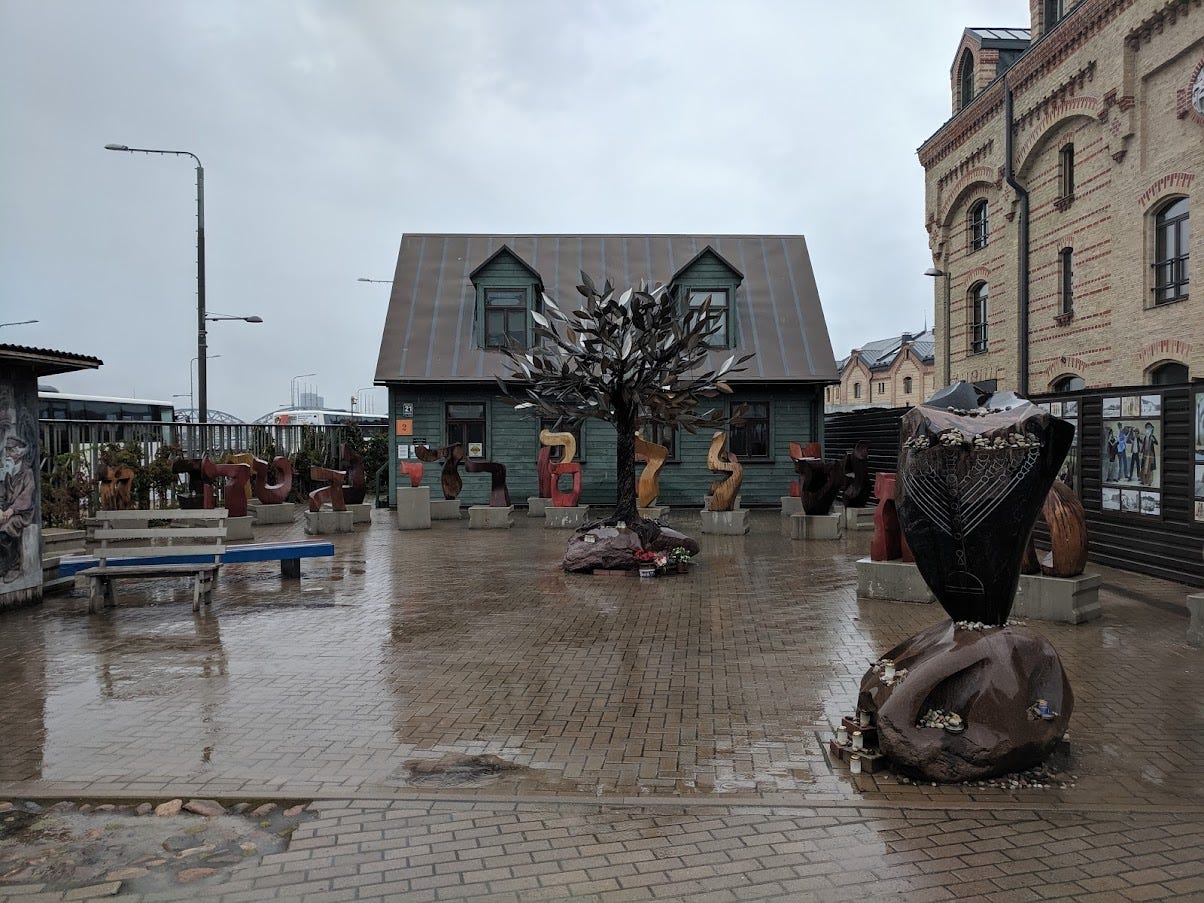
I was actually in the former Riga ghetto, now a haunting museum, almost exactly two years ago:
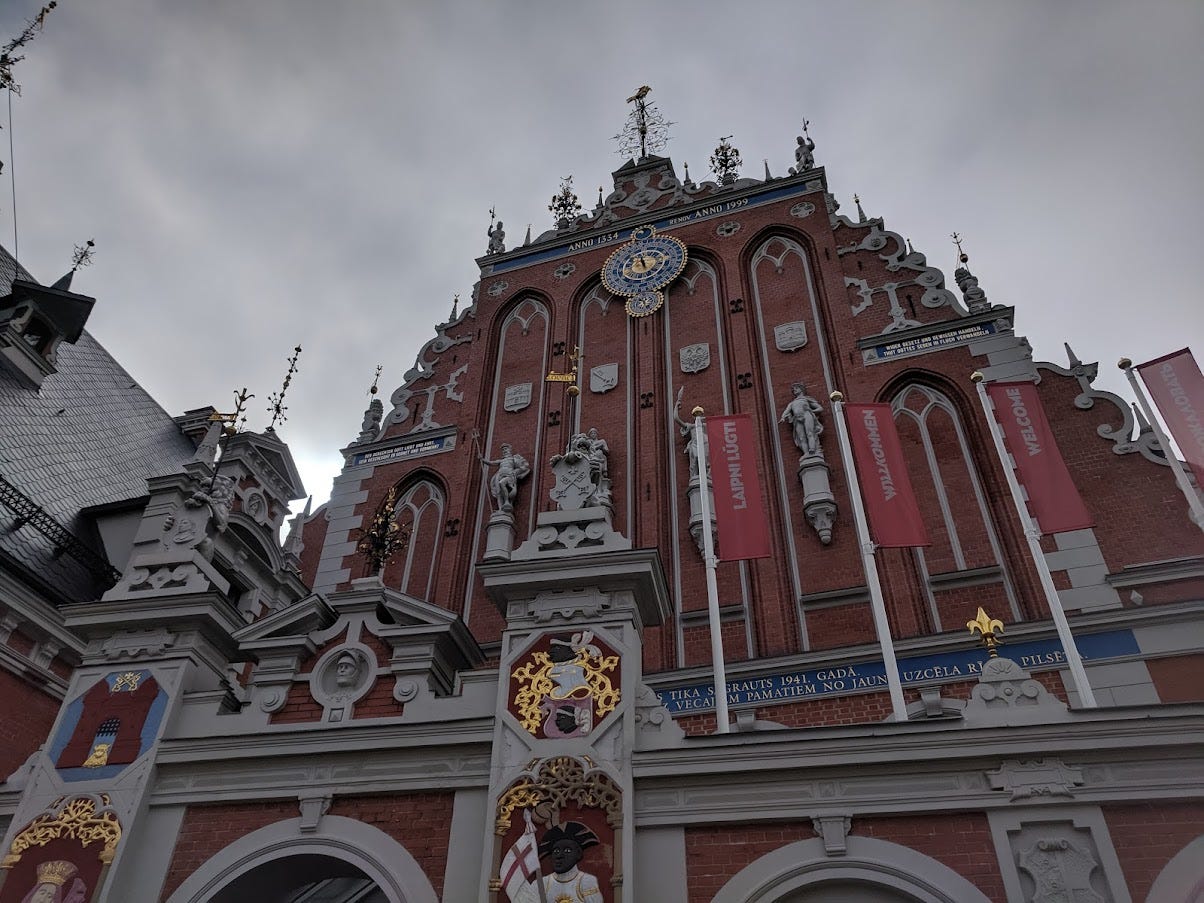
If you can get past all the historical murder (which is, to be fair, a prerequisite for enjoying just about any European city), Riga is a spectacularly beautiful place. Here’s a park near the city center:
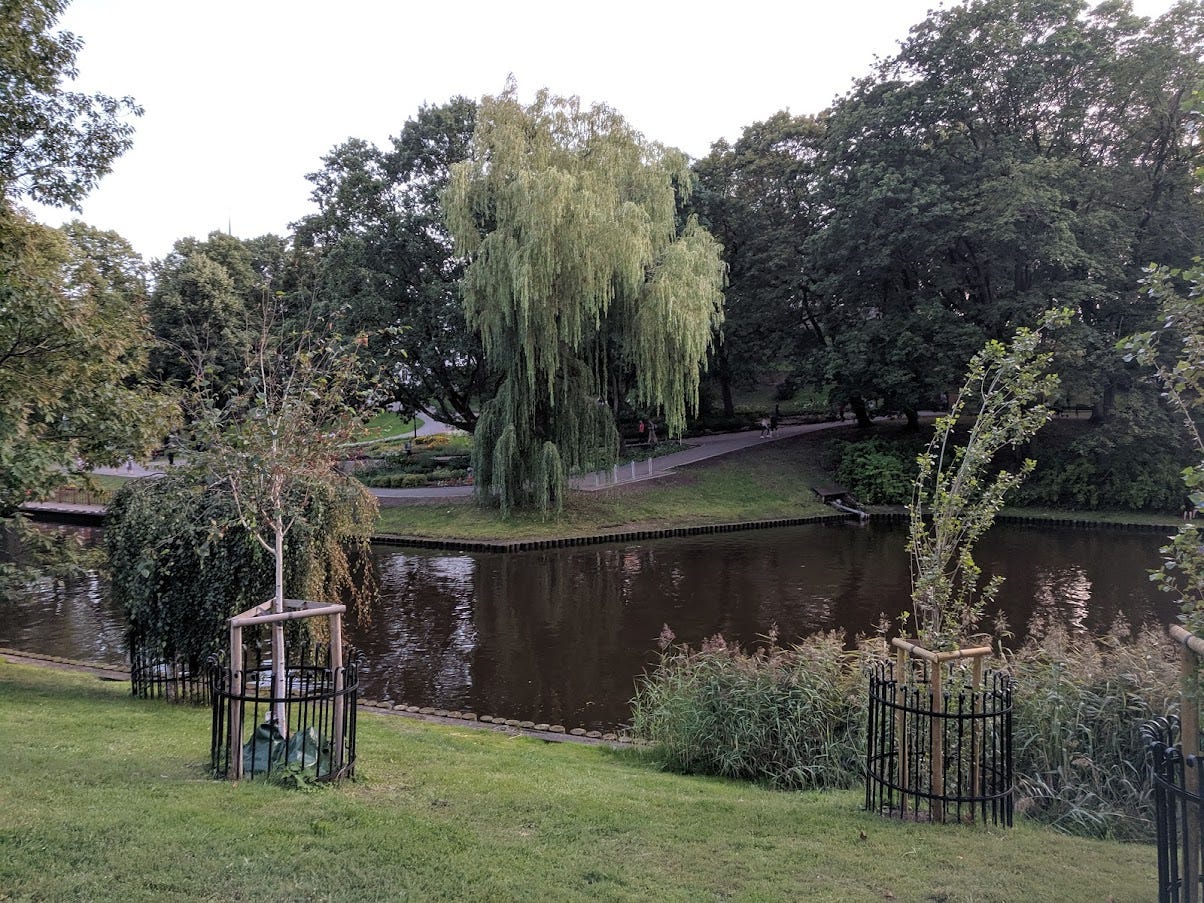
I went on one of those walking tours while I was there and the guide explained that 1) many of the trees were protected by fencing or wire mesh because there were a lot of beavers around that would otherwise destroy them; and 2) there was a famous, or at least famous-to-tourguides, incident in which a very drunk tourist got in a fight with one of those beavers and lost, badly. I want to say he was British, because this sounds like the sort of thing a British tourist would do, but I can’t remember for sure.
Anyway, beautiful city that I highly recommend. I feel like I was just there yesterday and it’s astonishing to think about how different my life and the world were two short years ago.
-On a slightly pathetic note, I really liked Slay the Spire, a video game I reinstalled the other night, immediately lost two hours to, and then promptly re-uninstalled. I’ve been through this cycle a few times now because it is one of the most devilishly addictive games I have ever played, as you can see from this page on Steam, a platform that lets you purchase and download games, informing me I’ve dumped more than 200 hours into it — that is, enough time to, say, become reasonably competent at beginner-level French (typing that made me wince).

I do not usually spend this much time on a video game at this phase in my life! I am recommending this game so that someone else’s life will be ruined by it, too, and we can commiserate. (Sorry.)
Readers Respond To My Post About Supposedly Asexual Tweens And Teens, “Your Personality Is Not A Sexual Orientation”
Andrew wrote in via email:
I thought your piece this morning about demisexuality and all these new silly flavors of sexuality made a lot of sense. I’m a gay man (late 30s) and agree with you that a younger generation seems to want to have some flavor of queer to feel more interesting when there’s no marginalization there approaching what an actual gay or trans person experiences.
Was surprised to see you lump asexuality in there though, at least among people old enough to have had real opportunities for sexual experience. The way I see it, homosexuality means you’re attracted to your gender, heterosexuality means you’re attracted to the other gender, bisexuality (or pan or whatever) means both. But what about the person who really just isn’t attracted to anyone?
Do we still make them straight by default and say they are just someone who doesn’t want sex and it’s a personality preference? I think there is a real group of adults who just aren’t attracted to anyone sexually, and it seems like there’s a need for a real category there (i.e. asexual) even if we recognize that inexperienced teenagers may not know enough yet to truly identify as asexual.
Just sharing my thoughts. I love the sub stack overall and the space you’re occupying to ask the right questions.
This may have been my fault for not being clear enough, but I definitely didn’t mean to imply there’s no one who could fairly be called ‘asexual’ or that when presented with someone claiming as such, our response should be: Naw, you’re just straight.
I was more trying to get at the fact that, especially among young and/or sexually inexperienced people, there does seem to be something going on where personality is bleeding into orientation, with the former being recast as the latter. If the term “sexual orientation” is to retain any meaning, the state of only being attracted to people you also have an emotional connection to (for example) shouldn’t be considered a sexual orientation. Rather, that’s a feature of your personality. Or so I would argue.
But I definitely think that some people are genuine asexuals! Along those same lines, reader C MN shared their own story in the comments of that article:
On the asexuality front: there is some evidence that SSRI use in child/teenaged girls may hinder sexual development. I'm a woman in my 30s who was put on an SSRI when I was 16, and would also identify as asexual (I have never experienced anything like what others describe as sexual attraction to either males or females, and I don't find sex or even masturbation particularly pleasurable), and I've long thought that being placed on an SSRI at that age contributed. Increasing SSRI use in children/teens could potentially explain a sudden surge in asexuality (though like you, I am not comfortable with children claiming that mantle, and think it's something that ought to only be "diagnosed", for lack of a better term, in true adulthood).
I have also been super frustrated at the lack of information about asexuality. There appears to be little research into what it is (or even whether it's a phenomenon common enough to study!). I have read more than one book that purported to be a scholarly look into the subject, only to find the exact same "resources" I found in 2014 floating around tumblr--at times, down to the exact wording. There are asexuality "textbooks" that cite youtube and podcasts as sources for information that they present as scholarly. It's very frustrating.
That is interesting speculation about SSRIs, though obviously there’s no way to know for sure and I can’t claim to know anything about that potential connection. But this comment nicely gets to what I was saying about WebMD’s treatment of this issue: As I noted, it included lines like “Asexual can also be an umbrella term that includes a wide spectrum of asexual sub-identities, such as demisexual, grey-A, queerplatonic, and many others” that seemed to have way more to do with internet culture as participated in by 10-18-year-olds than with actual, you know, medicine.
So I feel for you, C MN, and hope you can find better resources! You would think this would be an attractive subject of legitimate, rigorous study. This might be a less explosive version of what’s happening with gender dysphoria, where the subject is so politicized and so intertwined with the idea of unquestionable identities that it absolutely hampers the research, which will only harm people with dysphoria in the long run.
I think in 50 or 100+ years (to pick an arbitrary "future"), history will find that some of these categories are more "real" than others, in the sense of describing a distinct group of people, mostly stable over time. But I can't tell you which ones they're going to be. I do think some form of the "asexual spectrum" will be among them, though.
https://en.wikipedia.org/wiki/Timeline_of_asexual_history doesn't go back as far as https://en.wikipedia.org/wiki/LGBT_history, to be sure, but it's not a brand-new creation of the Zoomers, either.
(And I'm not sure why the evolutionary argument against asexuality is any different from the evolutionary argument against homosexuality, which I think you'd agree doesn't really seem to hold water.)
I agree with this take. Some of this stuff will turn out to be trendy and to not really map onto reasonably well-defined scientific categories, and some of it will prove more durable than that. Surely there will always be people who, for whatever reason, don’t feel sexual attraction. To me, the interesting question is: For what percentage of people who feel this way is it really an orientation, in the sense of not being connected to some other medical or psychological cause? I’m sure the answer isn’t zero, but how high is it?
As for Glenn’s mention of evolution, that’s a response to when I wrote, “It seems unlikely, evolutionarily, that there are that many true asexuals out there, meaning people who really and truly aren’t wired for sexual attraction,” emphasis in the original. There’s definitely a dunderheaded version of evo-psych in which people tell much too tidy stories: This must not be true, Because Evolution. As Glenn alluded to, one could make this argument about homosexuality, except a lot of sex researchers have come up with theories, like this one, that render homosexuality perfectly compatible with what we know about evolution. (Plus, sometimes stuff just happens and doesn’t fit so neatly into the broader puzzle of humankind, or at least can’t be placed comfortably into a survival-of-the-fittest framework.)
I was really just trying to say that I think asexuality is probably not as prevalent as you would think if you went to certain online communities, though now that I type that out it seems a potentially silly argument given that if you go to any community centered on a rare condition or belief, it’ll seem like lots of people have it. So I probably should have phrased this better or just not referenced evolution at all. That said, it would shock me if asexuality, as determined by self-diagnosis, weren’t ‘contagious’ in the sense of people who never would have thought of themselves that way quickly doing so after being exposed to the term online. And that’s more likely to be the case, again, among people who are very young or sexually inexperienced or both.
Readers Respond To My Post “On Wi Spa And Our Stunted National Conversation About Self-ID”
One correspondent, who is trans and who asked to remain anonymous, was not impressed with my post. Here’s what she said, with some numbers added by me so I can easily respond to certain points:
Dear lord, you have such a blind spot on these issues. (1) It’s like you can’t help but fall into using extreme fear-mongering language (“bullying”, “fucking insane” etc), even when you try to be relatively measured on other issues.
(2) All this “30 seconds ago” rhetoric is starting to get old for me, because you have been using it for at least a year now. “30 seconds ago” is now “30 seconds plus a year, and probably several more years in liberal parts of the world”. Society changes. People’s values change. That’s not a bad thing, in fact that’s a very normal thing. The only question is how quickly should it change – conservatives want to hold it back, progressives want to push it forward. It’s not helpful to make one side of the debate “this is gross and traumatizing and should never be allowed”, because it means we will never make any progress. The conservative side should be “society isn’t ready to abolish segregation, so we need to find a way to transition more slowly”.
The reason The Guardian and other outlets didn’t cover the actual event around the video, is because that’s not the interesting story! Who cares about one incident where someone got upset about a penis? Nobody got hurt that day. What is the interesting story is that this video resulted in protests, clashes with the police and an actual fucking stabbing. I.e. real harm. You spend a lot of time talking about how left wing activists focus on imagined harm over actual harm, but now here in this instance the media is focusing on the actual harm, now you want them to go back to talk about imagined harm? Which is it?
(3) You ask what the problem is with a pre-op or non-op trans woman going into the men’s locker room… Well, they’ll presumably be wearing women-coded clothing, for one! They might have breasts! Physical transition includes more than just the genitals. It’s a very difficult and confusing period in a trans person’s life, and they struggle to not be harassed no matter where they are!
(4) Personally, I think anyone with a Very Fucking Gendered genital configuration probably is asking for trouble by voluntarily getting into situations where someone might see said genitals. I have less sympathy for people who go to nude spas than bathrooms, since going to a nude spa is not really satisfying some basic bodily function. Having been through transition myself, I chose to avoid those sorts of spaces until I was post-op because I didn’t want the stress. It just wasn’t worth it for me. But that was my choice. Not everyone will make the same choice.
(5) The point is if the spa has a policy to allow pre or non-op trans people into the space that they choose to identify then… well that’s just the policy. Suck it up. If you don’t like it, go to another spa. There is a chance that an explicitly trans-exclusive spa might open itself up to legal challenges, but so far in America that track record isn’t good (see the Christian bakers vs gay couple case). Religion trumps sexuality in America, and I’m sure it would also trump gender identity, if any trans person actually bothered to bring a case over it. Which they probably wouldn’t since there is a trans-inclusive spa right there that they could visit. Either way, it seems ridiculous to complain about a trans-inclusive spa actually being trans-inclusive.
Okay, so:
(1) I do pride myself in using measured, nuanced language in most cases, so I agree that this is pretty heated by the usual standards of this newsletter. But let’s look at what I said to get the full context.
Here were my only usages of ‘bullying’ in the post in question: “Instead of this sort of discussion, it feels like the most common left-of-center responses when these issues are raised are gaslighting — not a term I use lightly given how frequently it is abused — and bullying. … The bullying is treating the people asking questions about males in traditionally female spaces as the perverts or creeps or bigots [emphasis in the original].”
I do think that if a female person expresses discomfort with having a clearly male person in (say) a locker room, and your response is to accuse her of bigotry, then it may well qualify as bullying, though of course it depends on the full context. So I stand by this.
As for “fucking insane,” here’s the context:
I guess what it comes down to is that I don’t ever want to be Tattoo Guy. I do not feel comfortable telling a woman who says “I don’t want a naked male in there with me,” “Nonononono, sweetie… You don’t understand. You think that person is male, but actually they’re a transgender woman, because they say they are, and therefore your complaint isn’t well-grounded.”
I’m sorry, but that’s fucking insane. And again, it doesn’t make you a bigot to say so.
I stand by this, too. There’s a basic maneuver that has really caught on in recent years here: pretend there’s no important difference between biological sex and gender identity, often by positing the former as fuzzy and not really knowable, but the latter as objectively and unquestionably true solely on the basis of someone’s testimony (meaning someone’s stated gender identity instantly and effortlessly overrides what we perceive about their biological sex). So to say to a woman, “You think you are sharing this locker room with a man, but because they’re trans, they’re a woman,” just isn’t fair or right, and involves logical contortionism, or at best the bad-faith, on-the-spot redefinitions of well-established, almost universally-accepted concepts.
A more accurate account of what’s happening is that the woman in question is sharing a locker room with a male person who identifies as a woman. I think that person should be treated as a woman in the vast majority of everyday settings, should be called ‘she,’ and so on, but to pretend this situation, which is going to occur more and more, involves no discussion and no potentially fraught tradeoffs is, well, insane.
So what should the policy be? Maybe it was cowardly of me, but I didn’t really try to address that in my article in much depth. Instead, I sought to criticize the ubiquitous-in-left-of-center-spaces claim that there’s no actual conflict here in the first place, that there are no tradeoffs to weigh, which seems like the first step. I certainly think everyone should have a place to change where they feel comfortable and safe.
But, moving on to (2), my correspondent writes, “The conservative side should be ‘society isn’t ready to abolish segregation, so we need to find a way to transition more slowly.’” But ‘transition’ implies an agreed-upon final state, and I think there’s an unwarranted assumption here that everyone is on the same page about where we’re headed.
It’s important not to succumb to presentism. At any given moment in history, people are making all sorts of claims about what the world should look like, what social justice entails, and so on. Some of them stand the test of time, at least as far as we can tell (expanded rights for gay people, including the right to marriage), and others we look back on wincingly (a disturbing number of mostly-European leftists insisting that we must break down the moral barriers stigmatizing pedophilia).
Obviously I am not directly comparing self-ID to anything as awful as endorsing pedophilia, but my point is that just because a bunch of influential people proclaim “This is the way forward” at a given moment, that doesn’t necessarily mean that’s exactly how things are going to pay out. And the choice isn’t, like, self-ID or forcing trans people back into the closet. If I had to guess, we are not going to look back at our present era and say that it was crazy we ever had sex-segregated spaces — the eventual solution will lie somewhere between Your biological sex determines where you change, full-stop and Your self-ID determines where you change, full-stop.
As indicated by (3), if we’re going to mostly retain single-sex spaces for now, this does present potentially difficult situations for many trans people. My correspondent writes, “You ask what the problem is with a pre-op or non-op trans woman going into the men’s locker room… Well, they’ll presumably be wearing women-coded clothing, for one! They might have breasts!” To be clear, I was referring to people who had undergone no physical transition. For people in that boat in gym settings, if a third space isn’t available, I do think we should at least be able to discuss the possibility that the best situation is to use the male facilities.
On the “women-coded clothing” thing, I mean… it’s a gym? You wear sweatpants and a ratty stained tee shirt to the gym (well, maybe in L.A. they dress up, or in fancier New York gyms I will likely never step foot in). Plus, I addressed that in my post: “No two individuals are alike, but it’s hard to see how a pre- or non-op trans woman would be at any more at risk in the male section of the Wi Spa than, say, a femme-seeming gay guy. Nothing about this individual’s body would mark them as different in a way likely to cause them danger.” My point there was that some gay men are pretty femme-presenting in their mannerisms or clothing or both. If a male person presenting in this manner isn’t safe in a gym locker room, that is a major issue that the gym in question needs to resolve before there’s an assault and/or lawsuits. But once you acknowledge that self-ID brings with it certain negative outcomes for women who don’t want to change in close proximity to males, I would argue that having trans women who haven’t physically transitioned at all use male facilities isn’t a prima facie ridiculous solution — unless, again, the gym has a rather horrific problem with transphobic and homophobic violence, which would be a whole other issue, and would bring danger to a much larger group of males.
I agree that for trans women who have undergone some level of transition, the calculus is different. I would never say that such a person should be forced to choose between using the male facilities or not coming to the gym at all. That’s a situation in which having a few unisex bathroom/locker-room options on site would be best, or in which other options should be explored.
(4) “Having been through transition myself, I chose to avoid those sorts of spaces until I was post-op because I didn’t want the stress. It just wasn’t worth it for me. But that was my choice. Not everyone will make the same choice.” I have sympathy for anyone in this situation, and it must be very difficult to go through. It’s important to recognize, though, that everyone has their own stuff going on, and while we have on the one hand trans people who are just trying to get through their day without harassment, like my correspondent, we also have on the other hand women who have been raised, from a very young age, to understand that males can pose them a threat, and that that’s why we need single-space sexes. A lot of them have likely had some experience that would make them leery about sharing a locker room with a male person, though of course everyone is different and I don’t want to claim to speak for all women on this.
So you could easily have a situation where a trans woman who poses no threat to cis women, but who wouldn’t feel safe changing around men, changes in a female locker room, and the women there feel creeped out by it, and them feeling creeped out causes anguish to the trans women, and no one in this situation is really wrong for feeling the way they feel. Again, I absolutely feel sympathy for the trans woman in such a situation. But I also feel sympathy for the cisgender women, because from their perspective, how are they supposed to know what they need to know about the male person in their vicinity in order to feel safe? Hell, for various cultural and other reasons a lot of women wouldn’t want to be fully nude even around a male they’ve been friends with for 30 years, or who was a direct relative, and so on. A stranger is a whole other matter entirely.
And note again that if you are a proponent of the idea that self-ID should be the only principle invoked to resolve these issues, your only move is to say that there is something wrong with the women’s actions, that they need to be educated out of regarding the presence of male bodies in their spaces as worthy of alarm or discomfort. And the only way to do that is to explain that what really matters is how the person with the male body feels about maleness (as in, they reject it), or that it isn’t a male body in the first place, since as soon as someone identifies as female they have a female body (which is an actual thing actual adults with actual credentials are arguing at the moment).
But in either case, this is a bizarre misunderstanding of why women demand female-only spaces; until the present moment, none of this has ever centered on males feeling male. It’s being male that is the potential problem. And being male is a pretty objectively identifiable thing in the vast majority of cases; asking women to believe that self-declaration changes one’s physical sex is asking them to buy into a religious belief system that directly affects them, in a way (for example) Muslims praying privately in a mosque does not. Religious tolerance relies on the religion in question not imposing on the tolerant nonbeliever in question.
What it comes down to is that sex is an undeniably potent force in our lives, written into our very DNA and having shaped our evolutionary history at every turn, and my only argument in this post was against the attitude that since “trans women are women,” natal females in Wi-Spa-like situations have no just claim to be apprehensive or fearful or squicked out when there is a male in a female space. I think they do. I also think trans women, whatever their state of transition, (obviously) have a right to use gyms, and using gyms often involves showering and using locker rooms. All of which is to say simply that any adult conversation about this is going to involve understanding all these different perspectives and forging reasonable compromise. The most popular left-of-center response at the moment, “Shut up and deal with it, bigot,” admittedly works quite well (in a sense) in many journalistic and academic and NGO settings, where expressing any qualms can quite literally put your career in jeopardy and where pluralistic ignorance about your colleagues’ opinions on these issues reigns, but that line just is not going to work on most normies, I promise you.
Which brings me to (5). I can’t say for sure what would happen if a gym in California decided to flout the law by re-instituting truly sex-segregated spaces. But that’s a very risky, potentially expensive move. So “go to another spa” doesn’t work, because if you live in California, or another state with these laws, genuinely single-sex spaces have now been effectively outlawed.
A last point on this email: Overall, it was a fair, well-done critique. But I did disagree with the claim “There is a chance that an explicitly trans-exclusive spa might open itself up to legal challenges, but so far in America that track record isn’t good (see the Christian bakers vs gay couple case). Religion trumps sexuality in America, and I’m sure it would also trump gender identity, if any trans person actually bothered to bring a case over it.”
In my view the idea that “Religion trumps sexuality in America” is a pretty big oversimplification. I mean, look at the trajectory on gay marriage: social conservatives were unfortunately able to stymie its spread until all of a sudden they weren’t, and now it’s the law of the land. And no one can claim that that there’s widespread transphobia or trans-skepticism among the most important cultural and educational and corporate institutions in the country — all these institutions are marching in lockstep, toward self-ID. Politics are a different matter because social conservatives still have some power there, have detected a serious opportunity in fighting self-ID, and so on, but the overall situation is complicated, and it just isn’t true that socially conservative, religious folks are in full control of how these sorts of situations play out. Not by a longshot. Which is good! If I had to choose I’d rather pick a world with widespread self-ID and diminishing power among social conservatives than the reverse.
For my final response, let’s return to that possibility that society will eventually move past single-sex spaces, as hinted at by arrow63 in the comments section.
He wrote, in part:
[]I'm not really sure this is that big an issue. I'm a gay man and I am extremely self conscious about changing in a male locker room. I'm sure most straight men find it more annoying to be potentially ogled by a gay man than having to have a naked woman who identifies as a man in there. And yet, to the best of my knowledge, there's never been any sort of proposals to segregate people by sexual orientation. And as you alluded to, that's actually a much bigger problem in bathrooms.
So people will probably adjust to the weirdness, which after all is the norm in Europe, where everything is nude and unisex. Our obvious solution, having privacy cubicles for anyone who wants one, won't happen because it's too easy.
I do want to note first that “privacy cubicles for anyone who wants one” probably isn’t that easy, since it would impose a significant expense on so many businesses and other institutions, and that it isn’t true that everything is nude and unisex in Europe — I think it varies greatly by region. (Though overall, yes, they are less puritanical about nudity, including the cross-sex variety.)
That side, this comment does point to a bit of fundamental incoherence in sex-segregated spaces. These spaces are an approximation. They’re basically a way of putting one possibility — men ogling or harassing women — at the top of our list of concerns and building out our bathrooms/locker rooms/etc. system around that. In this system, though, you still may well be changing next to someone you are sexually attracted to, or who is sexually attracted to you. There are tradeoffs here, too, regarding privacy and practicality. But there’s probably no easy way to improve on it, and plus, at the end of the day the vast majority of people aren’t looking to harass or assault anyone, or aren’t in a feasible position to do so, especially when the sexes are separated.
We should have humility, though — it could always turn out we were wrong or that history will look back on us incredulously. There is a chance that certain cultural mores will change so much, or (less likely) that there will be such a decline in sexual assault and harassment perpetrated by men, that at some point we won’t need or want sex-segregated spaces anymore, and will find them strange. So it’s useful to point out that this is already a bit of a weird, incoherent concept, even if it accomplishes most of what it is supposed to, at least regarding women’s safety and privacy.
But for now, it’s unfair to expect people to accept, by fiat, that sex-segregatd spaces are no longer relevant, that biological sex doesn’t matter.
Questions? Comments? Ideas for cool new third and fourth sexes? I’m at singalminded@gmail.com or on Twitter at @jessesingal. The lead image, of a mailbox stuffed with mail, comes from Tom Kelley via Getty Images.
> And yet, to the best of my knowledge, there's never been any sort of proposals to segregate people by sexual orientation
When I was growing up, this was a big concern. We've just decided to shrug our shoulders about it and go with it.
But we don't really have a problem with "women-in-men's-room," because the whole point of separate-sex places is to *protect women*. 10 years ago, Amnesty International was crystal clear that when setting up emergency shelters for displaced people, it was an absolute requirement to have separate bathrooms for men and women. To protect the women from the men.
Once we realize "the point of women's bathrooms/lockers is to protect women from men," we also realize that self-ID completely nukes that. Right now the way of squaring that seems to be to pretend that women *don't* need to be protected from men, which, well, good luck. Hope it works out this time.
"Who cares about one incident where someone got upset about a penis? Nobody got hurt that day."
This variety of "what's the big deal? where's the harm?" would be honest if more consistently also directed to the pre-op trans person, while escorting them to the bio-correct locker room/spa/hot tub.