

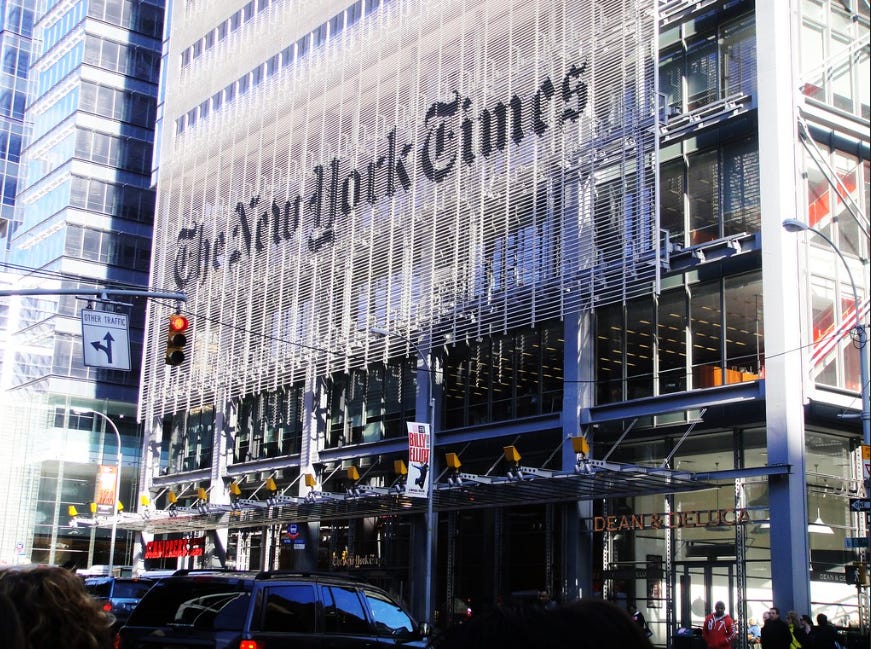
For anyone confused about the internal dissent that has been roiling at The New York Times, the Vox article “The New York Times staff revolt over Tom Cotton’s op-ed, explained” seems like just the thing. What better way to catch up on the controversy than to have it explained to you?
A brief review: A week ago The New York Times ran a column by Senator Tom Cotton saying that the feds should send in troops to quell rioters and looters. At least dozens of Times staffers revolted in disgust, with many of them tweeting the same sentence: “Running this puts Black @nytimes staff in danger.” When the smoke had cleared, the editor of the editorial page, James Bennet, had resigned, and James Dao, the editor “directly responsible for the Cotton op-ed,” as Vox put it, was “transferred to a different role.” Something that felt like a realignment had occurred: Staffers on the news side had exerted a massive influence, for better or worse, on the traditionally firewalled opinion side of the paper, and the Times admitted to major lapses in editorial judgment (falsely, in my view, and in light of some of the evidence the Cotton camp provided).
Then Bari Weiss, a centrist-y opinion staffer who is not popular among her generally much more progressive colleagues, and who is a frequent subject of controversy in New York media circles (which tend to be pretty loathsome, to be honest), joined the fray. During the uproar but before Bennet’s firing, she tweeted that a “civil war” at the Times could help explain what was going on:

This, in turn, launched a major pile on in which seemingly half the Times staff went after Weiss for having voiced what they viewed as a ridiculous, offensive opinion.
The fact is, Weiss is correct. I have some qualms with how she framed things, which I laid out on the podcast I host with Katie Herzog (and here’s our take on the Cotton column and initial staff blowup — both these episodes are free), but overall there is absolutely a divide along the lines of what she suggests. I’ve written about it before, sometimes describing it, in an admittedly oversimplified model, as the difference between rightside norms (which animate journalism geared at chiming in on the “right” side of a given controversy) and accuracy norms (which animate journalism geared at finding the truth). From where I sit, many if not most mainstream outlets are becoming increasingly predictable and geared at broadcasting that they are on the right side of issues rather than digging deeply and intelligently into them.
At the moment, I don’t really want to get into how much of this is “safetyism” versus “rightside norms” versus a retreat from “classical liberal values” versus whatever else. Whatever you want to call it, the point is that there is a massive, vital fracturing going on in many media outlets, and it has to do with fundamental questions about the basic rules and norms that should govern journalism at all levels. The DMs and texts and emails I have been trading with people at other outlets suggests we’re at — or maybe past — some sort of strange and foreboding tipping point. Some journalists feel like they can’t pitch or write stories that most of the country would find uncontroversial, simply because such stories are likely to spark an uprising either among their own colleagues (mostly the younger ones) or among other journalists on Twitter (ditto). As I explained on the podcast, drawing on my own experiences, editors seem to care far more about what other editors and writers are saying on Twitter than they do about what the general public thinks about a piece, in part because the former is so much louder and more proximate.
In addition to knowing that this stuff is going on at various outlets, I also happen to know that Weiss is correct that at least some Times staffers believe something bad is in the air over there. I know this because I have had real-life conversations with two Times staffers who have told me exactly that (I’ve also met Weiss at least a couple times, so I’m not counting her). The problem is, if you mention this publicly, as Weiss did, you will have the full weight of your colleagues come down on you. It was genuinely disturbing to watch this time around. A group of Times staffers who had just spent a solid chunk of time publicly bashing their colleagues on the opinion desk suddenly changed the rules, in real time: It was beyond despicable that Weiss had had the gall to. . . criticize her colleagues publicly. Just search her name on Twitter and see the sorts of stuff her colleagues were saying, all in response to criticism that was rather milquetoast and which didn’t name any particular section or staffer.
Okay, so: Back to Vox. (I promise this will make sense at the end.) Zack Beauchamp, a senior correspondent there, decides to explain the situation, in classic Vox fashion, for the lay reader.
What results is a really, really bad piece by journalistic standards. And I want to carefully explain why it’s bad, because it gets at exactly the issues that hardly anyone seems willing to talk about openly at the moment. At root, it’s an example of what happens when a journalist approaches an issue much more sympathetic to one side than the other, and therefore adopts wildly inconsistent evidentiary standards to the reporting process.
I realized reading Beauchamp’s column was going to be a rough ride very early on:
One narrative of these events, circulated most prominently by staff editor Bari Weiss in a Thursday tweet thread, cast the conflict in ideological terms: an internal war between free speech advocates and young social justice warriors. But Weiss’s characterization was widely rejected by her colleagues; several Times reporters I spoke to, all of whom asked to remain anonymous for fear of retaliation, cited professional concerns as the reason for the public disagreement. (Times representatives did not respond to my request for comment.)
This is what I mean about different evidentiary standards. The phrase “for fear of retaliation” gives off a sinister vibe that suggests the staffers are at risk here, and that Weiss herself could cause them trouble if they speak up — she could retaliate (or someone could, at least — it’s unclear who would even be doing the retaliating). Of course, this doesn’t make much sense: A huge chunk of the anti-Weiss contingent spent hours openly bashing her on Twitter, with no consequences. Why should Vox credulously pass along their claim that these staffers fear retaliation after so many of them just did the thing they now claim they can’t do? I mean, it might be the case that they’d be treated differently by their employer if they spoke to an outlet versus tweeting — that’s reasonable — but if that’s the case, just write that. What does it even mean to bring up the idea of retaliation here, when it’s strikingly obvious to anyone keeping even one sleepy eye on this story that Weiss’s antagonists all feel perfectly comfortable bashing her publicly on Twitter? This phrasing is a sign of a slanted story, of Beauchamp accepting, at face value, claims from the anti-Weiss camp that warrant a bit of vetting.
But there’s a lot more of that. After making the point that bringing in troops could worsen rather than calm things, Beauchamp writes, “This is the meaning of the protest that ‘running this op-ed puts black New York Times reporters in danger’: If Trump were to send in the troops, it could lead to harm to Times reporters who are covering protests or merely walking near them while black.” This is the most radical claim the Times’ internal critics made, and Beauchamp barely tries to explain it — he just sort of reframes it and expands on it. But “bringing in the troops could make things worse” is, of course, a different argument from “troops could gun people down just for being black.” Does Beauchamp think that this is a realistic concern? Are American troops going to gun down black journalists? He doesn’t say — we’re just sort of supposed to accept that claim at face value. Because it’s the “right” side of this argument.
Beauchamp goes on to complain that in Cotton’s column “there is no acknowledgment that governors and mayors don’t actually want the military deployed.” This is just false. In his column, Cotton writes, “Some governors have mobilized the National Guard, yet others refuse[.]” Then, in service of the claim that the real issue here is that the Times’ opinion page holds conservatives to a different, lower standard than liberal ones, Beauchamp mischaracterizes another column, referencing Bret Stephens’ “March 2020 piece about how Woody Allen was a misunderstood victim of cancel culture,” and citing it as an example of how Stephens “embodied an ethos of ‘owning the libs’ at any cost that much of the newsroom found galling.”
In the column in question, Stephens makes the eminently reasonable argument that it is a bad sign Allen’s book was dropped by Hachette after an employee outcry. As any adult understands, this is separate from the question of whether Woody Allen is himself good or bad or guilty or innocent or understood or misunderstood. Stephens himself doesn’t even express an opinion about the allegations against Allen — rather, he sums up the evidence: “[Allen] has always categorically denied it; he has never been charged with doing it; and two formal investigations, one by the Yale-New Haven Hospital and another by the New York State Department of Social Services, exonerated him. For her part, Dylan insists the accusation is true, as does Ronan, who calls it ‘a credible allegation, maintained for almost three decades, backed up by contemporaneous accounts and evidence.’ ” Then Stephens acknowledges: “None of us will ever know the truth for a certainty.”
To boil all this down to the thesis “Woody Allen was a misunderstood victim of cancel culture,” is, again, a sign of a journalist writing with a very particular agenda in mind — to slant the evidence in favor of the claim that the Times had a major problem with the quality of its op-eds, that the Cotton column was just the latest manifestation of that problem, and that therefore the staff outcry and personnel decisions were justified. Because that’s what the employees behind the outcry want everyone to believe, and they are on the “right” side.
After posting Weiss’s tweetstorm, Beauchamp continues:
It’s easy to understand where Weiss is coming from here ideologically, especially given the prominence of somewhat oblique complaints about putting black staffers in danger in the public discourse surrounding the op-ed. The interpretation, as she says in the thread, pretty neatly confirms her prior beliefs about the dynamics of public life in the era of “woke” politics.
But that doesn’t make it right.
“I am in the same meeting that Bari appears to be livetweeting. This [is] inaccurate in both characterizations,” Max Strasser, an opinion editor, tweeted. “It’s not a civil war, it’s an editorial conversation; and it’s not breaking down along generational lines.”
But Weiss wasn’t tweeting about any specific meeting. She wasn’t! Or at least there is literally nothing in her tweetstorm to suggest that. In my reading, she was clearly just tweeting about the general internal dynamics at the Times. There is no mention of a meeting, or any specific event at the Times, whatsoever. Weiss also writes “The dynamic is always the same” and mentions two very different established sides with their own belief systems, both of which are incompatible with the idea that she was writing about some ongoing meeting.
Strasser appears to have misunderstood this, and this quickly set off an unfounded rumor — Weiss was dishonestly, or at best inaccurately, relating an ongoing internal staff meeting — that a bunch of other Times staffers (professional journalists at the most important newspaper in the world) spread without checking. (Disclosure: I worked with Strasser on one of the two pieces I wrote for the Times, and Weiss on the other. All my experiences with both of them were positive, and I don’t think Strasser intended to be misleading here.)
It would have been very easy for Beauchamp not to have further amplified this unfounded rumor. He could have, for example, reached out to Weiss. But there’s no sign he did. Or he could have read the tweetstorm slowly and carefully and compared it to Strasser’s account, perhaps reaching out to Strasser to ask him where he saw any sign Weiss was livetweeting an ongoing meeting. He doesn’t appear to have done that, either. Why? Say it with me: Strasser is on the “right” side of this, and these claims don’t need to be vetted as carefully.
That can help explain why Beauchamp included another tweet suggesting Weiss was spreading misinformation about a meeting she wasn’t privy to:
My own conversations with Times staffers gave the same perception: Weiss seemed to be ginning up this “controversy” largely out of thin air. In Times discussions on Slack, its main work communication tool, the staff appeared largely unified around opposition to publishing the op-ed.
“I’ve seen way over a hundred people posting comments, into the hundreds if you count people posting supportive Slack response emojis, and not one person pushing back,” said one Times staffer. “The idea of a big divide or internal argument just has no basis that I’m at all aware of.”
Let’s review this. Beauchamp, in his authoritative-sounding “explainer,” wants you to know that “Weiss seemed to be ginning up this ‘controversy’ largely out of thin air.” His evidence is that the staffers who hate Weiss told him that. Their evidence, in part, stems from the fact that people who disagree sure are being quiet on Slack — that is, in a venue that is open for the whole company to see (except in the case of private channels), and the contents of which frequently get leaked to other media outlets. Also, Beauchamp never attempted to contact Weiss, if only to get her side and to ask her to put him in touch with her allies.
This is comically credulous journalism.
***
I think it’s the part about not contacting Weiss, or making any meaningful effort to seek out dissenting views within the Times, that really gets my goat here. I mean, it’s amazing what you can fail to find if you just don’t look, right?
I’m not saying that if Beauchamp had done more reporting he would have found people willing to speak up — I think a very clear example was made of Weiss that was designed, intentionally or not, to render clear the punishment for speaking up. But the fact of the matter is that if I — me, the guy who works from athletic shorts and sometimes doesn’t put pants on until noon or later — know people at the Times who agree with Weiss, there have to be others. To not even attempt to reach out to them, and to then confidently and breezily state, in that detached faux-journalistic tone, Hey, I seriously looked into this and as far as I can tell there’s not really anything to Weiss’s claims. . . you can see why I’m frustrated by journalism right now? (Update, 2/16/2021: Back in November New York magazine published a much longer, better-reported piece by Reeves Wideman that represents a far less biased attempt to understand the internal dynamics roiling the Times. And wouldn’t you know it: “While Bari Weiss’s description of a young woke mob taking over the paper was roundly criticized, several Times employees I spoke to saw truth to the dynamic. They scoffed at the idea that Cotton’s op-ed had put Black employees in danger, and were annoyed that the paper’s union had presented a list of demands that included a more formalized process for sensitivity reads on stories before they were published — a union representative said they just wanted to make sure employees are compensated for doing this work — wishing that the union would stay out of editorial issues and focus more squarely on its upcoming contract negotiation in the spring, when it hopes to reap some benefit from the company’s financial success.” Again, this internal disagreement was no one’s idea of a secret, even as Vox presented it to its readers as almost wholly imaginary.)
Right up to the end, Beauchamp continues getting basic factual stuff wrong: “But commissioning an op-ed from the loudest proponent of this view — the Times reached out to Cotton, not vice-versa — does not put the views in proper context.” This, too, is false. As National Review reported: “The original pitch to the paper on Monday was to package together the argument on the Insurrection Act with another proposal, but the editors were interested in a piece focused solely on the Insurrection Act. There was ‘haggling,’ the Cotton staffer says, ‘over what the angle and point of the piece ought to be.’ ” Clearly the Times didn’t “commission” an op-ed from Cotton — rather, the editors responded to a pitch which emanated from the Senator’s office by asking him to take a different angle. Once again, the errors and mischaracterizations in Beauchamp’s piece all seem to point in the same direction of making the Times’ editorial page look bad and reckless, which is what all his sources want.
A final note on the claim that the Times opinion page under Bennet held conservative writers to a different standards, and that this, in large part, motivated the righteous staff revolt: I think this is completely bonkers. The page, like any outlet churning out a huge amount of opinion content covering a broad-ish swath of the opinion spectrum, publishes laughably silly left-of-center takes all the time, some of them rather inaccurate.
I have firsthand experience with this: The one time I was mentioned in a Times column, the author simply took a crucial, 750-word part of my Atlantic story on gender dysphoric youth, flipped the sentiment expressed therein 180 degrees, and claimed that was my view in an attempt to make me look like a heartless reactionary. Then, she cropped a quote from a part of the story about young people (who cannot legally consent to medical treatment), presented it misleadingly as being about adults, and used it to argue that I thought doctors should be able to prevent her and other trans adults from obtaining medical care, which is an opinion I have expressed exactly nowhere.
These were not claims that would have survived even the most cursory fact-checking, and yet they appeared in the paper of record. Dao let me set the record straight in a letter to the editor, but he didn’t offer to correct the piece, and it is remarkable it ran in the form it did.
So no, it makes no sense to me to claim that conservative columns were held to some different, much lazier standard. Beauchamp could have at least found some people pushing back against this thesis if he’d done more reporting. But why do reporting when, more than ever, it is vitally important to show that you are on the right side of a simmering controversy — and maybe even career-threatening to do otherwise? The Twitter trolls within journalism can get awfully mean, after all, and the powers that be are listening to them more and more.
Questions? Comments? Requests for me to return to a less indignant tone? I’m at singalminded@gmail.com or on Twitter at @jessesingal. The photo of New York Times building comes courtesy of Nenstra on flickr.
Teaching writing in school, we tell students that their choices of claims, evidence, and strategies should take into account the audience for their work. A lack of clarity about who constitutes the audience for different kinds of journalism underlies some of the current fights. An imaginary "reasonable person" who weighs competing facts before arriving at a considered conclusion has served as the idealized reader for journalists and shaped the profession's norms and practices. While things were never quite so simple, market fragmentation driven by the internet has complicated the issue further and introduced incentives that have yet to be fully taken into account when journalists think about who they are, what they do, and whom they serve.
I've long thought the scoop-obsessed, access-driven political reporting that White House correspondents produce had an audience mainly of other, similar journalists. The relevance of what Ivanka Trump thinks about some event will evaporate almost immediately, but getting the goods on this kind of palace intrigue shows other reporters that you have the sources, skills, and savvy to wheedle quotes from high-placed officials, which, in these circles, represents the coin of the realm.
Previously, different kinds of journalism — investigative, exploratory, even opinion — responded to different incentives, but as Jesse points out, that perhaps no longer applies. If the industry continues to rely on advertising to pay the bills, then financial incentives will increasingly push outlets to maintain their audience by telling readers what they want to hear. And who reads journalism? Journalists and people culturally similar to journalists (typically college-educated, mostly urban folks). And what do they want to hear? Pretty much what Beauchamp is telling them.
Having one's priors validated feels better and takes less effort than considering inconvenient facts that fail to fit a clean and righteous narrative. As the college-grad readers who frequent sites like Vox vote with their clicks, the news will slowly adapt to a more ideologically-driven reader without admitting anything has changed— unless, that is, writers and editors make conscious choices to recommit to traditional reporting norms and to cultivate an audience that understands and respects this kind of knowledge production. Otherwise, the broader economics of news will keep pushing sites like Vox toward supplying ideological comfort food, and their passionate and influential audience will view themselves, wrongly in this case, as those idealized readers with a firm grasp on the truth.
Like C MN and Anon, I am terribly concerned about where one goes in our hyper-partisan world. Oh sure, one can withdraw from the battles -- for now. That's what people do in the Noelle-Neumann world we inhabit. Keep your head down and don't make waves. A few, like Jesse Singal, who is a lot braver than me, will say what they need to say--but there aren't actually many profiles in courage. Now Jesse also has an independent revenue stream (our subscriptions--for what they are worth), and I imagine that might help preserve him on the day those people who are absolutely certain they are on the right side of history come for him (I know Jesse has faced this already from some trans activists, and I learned here that he's previously had problems with the "Times").
What can the middle -- call it the "radical" middle, as opposed to the merely disengaged -- do? I actually am cancelling my subscription to the "Times." I've been considering it for some time, and their moving toward something like struggle sessions became my final straw (unlike the conservative columnist Kevin D. Williamson who excoriates their op-eds but subscribes for the excellent news content). So what?
Caught between the Trumpistas and the Right-Siders, there's no particular home of any size where one (I, at any rate) can be at home. But it's worse than that. There's a lot of momentum toward...toward what? Toward something more authoritarian. I've finally come to the conclusion that the culture war won't end well.