

Prove Me Wrong: Luck Determines Almost Everything
Thoughts on Cubans and Americans
Do we talk openly and frequently and loudly enough about luck? I don’t think so. Yes, it’s a frequent subject of conversation; we’re all quite aware of random hit-and-runs and lottery tickets and unwelcome masses found, too late, in loved one’s bodies. But we treat luck as the exception rather than the rule, as though it occasionally pokes its head into our lives, quite consequentially, for better or worse — Surprise! — but is usually a bit player.
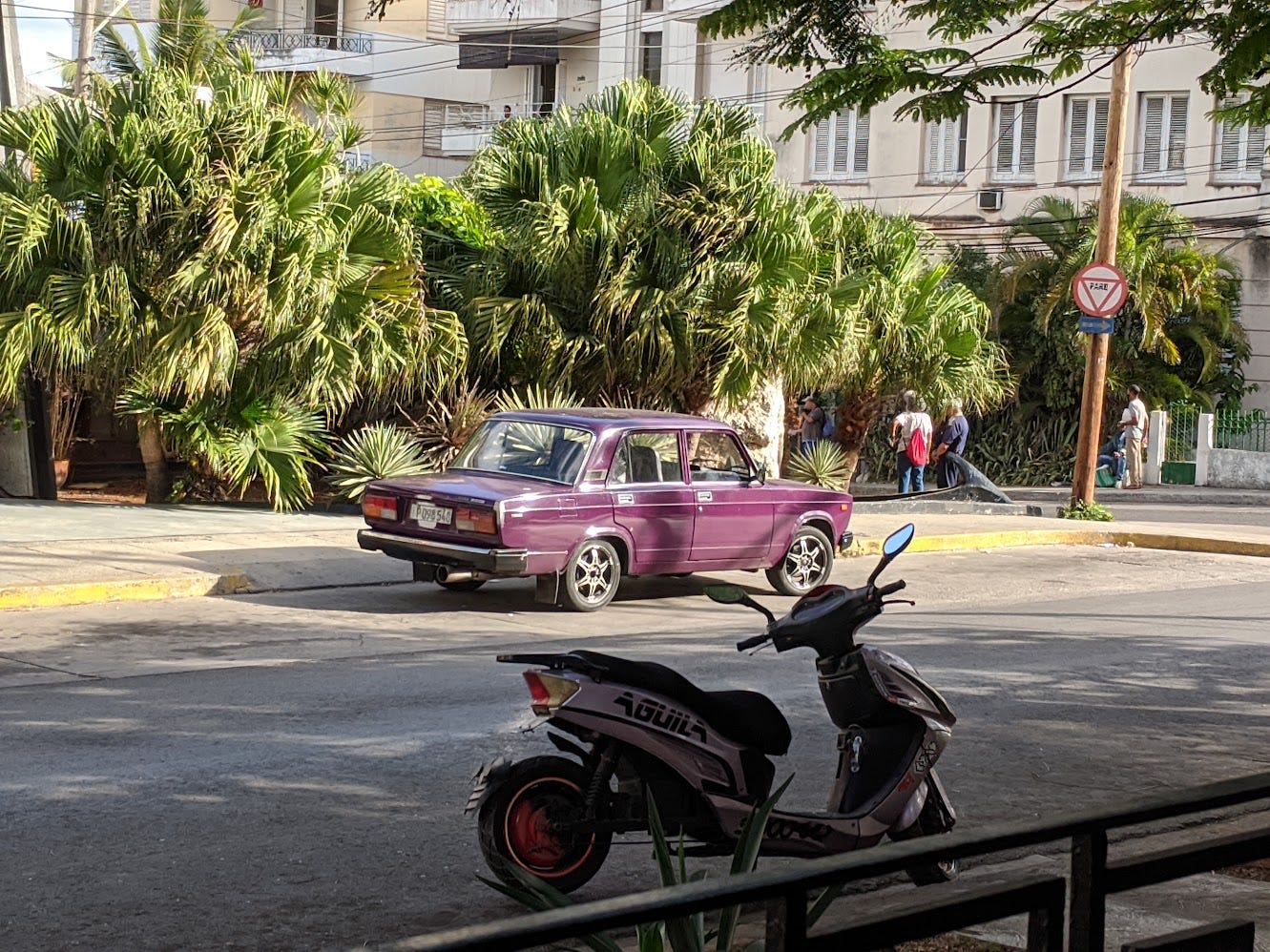
Take Cuba. I went there in 2022 with a couple of friends. Coincidentally, these friends were probably the only two people in North America who know less Spanish than I do. A lot of Cubans know only limited English, so I did most of the talking.
I will be honest: I read a couple of books on Cuba beforehand (I thought Ada Ferrer’s was excellent), but I did not do nearly as much research as I should have prior to such an incredible travel opportunity. Work, life, et cetera. So going in, I wasn’t sure how forthcoming Cubans would be with a goofy American who spoke toddler-level Spanish. The answer was: very.
It was mostly our drivers we had the most in-depth conversations with. After the normal where-ya-from pleasantries — our shared knowledge and touchpoints often centered on Florida — I would try to tactfully and nonchalantly ask, like, “¿Qué es la situación con la economía?” (not how a competent speaker would ask that question), [TKFN — I’m writing this from a library and as I was typing this sentence I overheard a kid starting a Spanish lesson.] and the drivers would often then go off, at length, about how absolutely screwed everything was.
They mostly directed their ire at their own government. U.S. sanctions (which are ridiculous) did come up, but that just wasn’t where they put the blame. They told stories about the massive numbers of people who have fled, the ridiculous bureaucracies they’d endured, the corruption, the difficulty of getting basic goods. Cubans have been dealing with all of this for a very long time and they are generally not — to stereotype a bit — a retiring people.
At the two countries’ closest points, 90 miles separate Cuba and the U.S. Ninety miles separate the richest and most powerful country in human history from one of the most dysfunctional economies in the Western Hemisphere, from a place they tell you to bring Advil and tampons to if you want to help the people stuck there. What separates being born in the U.S. versus being born in Cuba? Is it a lot less than 90 miles, or a lot more, cosmically speaking?
It was hard not to think about this constantly. We were fine, of course. The government has a fixed, set rate exchange between the Cuban peso and the dollar, but this rate effectively ceases to exist once you’re outside the airport and its money-changing kiosks. [TKFN More details from Reuters in 2024: “Cuba has three effective exchange rates. The government has a fixed rate of 24 pesos to the dollar, plus a ‘discretionary’ fixed rate of 120 pesos, used for example for services for tourists and gasoline. And then there is an informal one, which was trading at around 320 pesos to the dollar on Tuesday, according to a tracker provided by independent news outlet El Toque.” I don’t think we encountered quite as wild a street-to-airport ratio as 10:1, but if memory serves 5:1 wasn’t unusual. If you go to Cuba do not, under any circumstances, change your money at the airport or any “official” place!] Because their own currency is so broken, Cubans are voracious for realer currency, for dollars and Euros.
This meant we got “amazing”-seeming “deals” on everything. We visited the stores with the mostly empty shelves out of morbid curiosity, out of tourism, and then we went to get dinner at the places only tourists and the luckiest Cubans could afford. We tipped well and shrugged and were conflicted about all this. I know this all sounds green or naive to readers who have traveled in truly poor places, but the poorest place I’d been, before Cuba, was Bolivia, and Bolivia is not poor compared to Cuba. I had not been in any place where a single dollar could go so far, where I was walking around with the equivalent of a life-changing fortune for most of the Cubans I passed on the street.
I was reminded of this trip, and of luck, after I read a New York Times article headlined “Cuba’s Long-Suffering Economy Is Now in ‘Free Fall’ ” “By all accounts, Cuba is enduring the worst economic moment in the 67-year history of its communist revolution.” It’s very difficult to imagine what this must be like. You should read the article, but just one example: “To buy gasoline, people have to use an app to sign up for an appointment — at least three weeks in advance. One resident of Havana, the capital, said he joined the queue three months ago, and is now No. 5,052 in line.”
Here and elsewhere, I can’t get over the luck thing. People will offer this or that explanation for who gets what and who lives and who dies, and I keep coming back to Seems like it’s just luck.
If I told you I thought just about everything came down to luck, how would you respond? Is there even an argument against this?
There’s a clear connection between how much you believe in luck and what sort of society you think we should have. If you think people get what they deserve, more or less, setting aside the occasional, baffling hit-and-run, then there isn’t much of a need to try to engineer a better world. The world works well enough as it is. If, on the other hand, you think a fundamental unfairness is baked into everything, it’ll make you want to change the world. (You might overdose on this logic and decide to become a communist revolutionary.)
