

(A couple readers strongly disagreed with my piece about Ma’khia Bryant, and I’ll address their pushback in my next newsletter.)
I got a pretty big response to the article I wrote about gender earlier this month. Read it if you haven’t, but the basic argument:
I’ve found much of this conversation to be really aphilosophical, if that’s the word. Contemporary gender discourse isn’t really undergirded by any strong, stable sense of what we’re trying to determine, or what values we hold, or what shared realities we can agree on, or where there might be (gasp!) conflicts or tradeoffs inherent to some given instance of ideological/metaphysical zigging rather than zagging, or zagging rather than zigging, on certain questions.
And so on. I want to extend this conversation in a couple different directions: First, by responding to a smart followup email I got, and second, by critiquing a passage from a philosophical treatment of these subjects.
First, an email from a new subscriber:
Jesse,
I subscribed because I really wanted to read that one post – the one entitled "What Is The Goal Of Our Great Big Gender Conversation?". But it didn’t turn out to be what I thought it was going to be – I thought it was going to be a post talking about the fact that there’s all this stuff that nobody talks about, and while I can’t really complain about it not being what I thought it was going to be, I CAN beg you to do the post that I thought this one was going to be, namely one asking these two questions:
One: Why is nobody talking about what gender even IS? The word takes up so much space in the culture wars but what IS it? Nobody seems to know, and, more bizarrely, nobody seems to care enough to ask. It’s supposed to be inherent, born-in, immutable, and yet distinct from sex, but beyond that, it’s like there’s this unspoken agreement that we won’t explore what it IS (probably because it’s so obvious everybody that nobody, including themselves, knows what it is – it’s an emperor’s new clothes situation.) (There’s a really good convo between Andrew Sullivan and Dana Beyer that gets into the first question, above, a little bit, but that’s about all I’ve found on this.)
Second: Why is nobody asking, okay, if gender is NOT a social construct but an inherent trait, then what do we call all the constructed stuff that we USED to call gender, and what role does IT play? You know, how we dress, what work we do, behavioural codes, etc. The currently acceptable discourse seems to either ignore these things completely, or take them, too, as somehow part of nature, weirdly.
Please please please do this post! SOMEBODY has to do this!
Fine!
On the first issue: Yes, ‘gender’ doesn’t really mean anything anymore. Traditionally, it meant something like this, from the World Health Organization: “Gender is used to describe the characteristics of women and men that are socially constructed, while sex refers to those that are biologically determined. People are born female or male, but learn to be girls and boys who grow into women and men.” (Of course, the straightforwardly true claim that [almost] everyone is “born female or male” is itself now considered problematic — sex is now viewed as ‘assigned,’ not innate — which nicely shows how quickly elite language on this subject is mutating.)
There’s no choice in this. You are gendered male or female, in the sense that society expects certain things of you once you are clocked as male or female. This understanding is really important to basic feminist analysis. Because of how females are gendered, they are treated in certain negative manners, stymied from some opportunities, etc. etc. (Gender can harm males, too, of course, albeit in different ways. A male who is crying in public will likely engender [do you see what I did there?] different reactions than a female who is crying in public.)
These days, if you read about ‘gender,’ you’ll see that it stands in for everything from “biological sex” to “gender roles” to ‘gender’ (as in, the traditional definition) to “gender identity” to various other stuff. Sometimes people will start a sentence using one definition and end it using another. Gender is a grab bag, a rorschach, a messy playground. It’s very confusing! But most of all, we’re told, over and over again, that people get to define their own gender. It isn’t something someone else can impose on them.
Like so much else about our grand gender moment, there’s something worthwhile here. If the argument were “People shouldn’t be able to tell you that just because you are female, you must act in a submissive, deferential manner,” then, sure. But what’s going on is something more like “people shouldn’t be able to tell you that you are female.” As in, you get to decide how you are gendered and sexed, and if people disagree with your self-assessment of either, they are wronging you gravely.
Why does this matter? Because of course there are important differences between an understanding of gender as an external thing imposed on someone by dint of an immutable characteristic (their sex) and an understanding of it as an internal sense that can either be respected or violated by others, and which sex actually piggybacks on (as in, if someone feels their gender is ‘woman,’ their sex is female too, as many presently argue). These are very, very different conceptions that will take us in wildly different directions. The reason there’s such intense pushback whenever someone suggests that the burgeoning progressive understanding of gender entails tradeoffs is because it so obviously does.
There are a million ways in which the new understanding would, if this were an actual conversation, cause us to totally rethink quotidian situations. If a woman is on a subway car alone late at night and tenses up because someone who appears to be a large man gets on, nobody really thinks that if actually the man-looking person doesn’t feel like a man, that should assuage all the woman’s fears. Until 30 seconds ago “feels like” had nothing to do with this conversation because it was understood by everyone that the woman’s female-ness and the man’s male-ness, neither of which was a choice, play an important role in this situation, both biologically and socially.
Here is where someone pops in to say A-ha — you are accusing trans women of posing a threat to cis women! I’m not doing anything of the sort. I’m pointing out that the idea that sex and gender are determined solely by someone’s subjective sense, and that anyone’s conflicting thoughts on the matter should be angrily and automatically discarded, clearly causes certain conflicts that we should probably resolve before accusing anyone who doesn’t buy this model 100% of being a bigot.
Which brings me to the second point raised in the reader’s email: “if gender is NOT a social construct but an inherent trait, then what do we call all the constructed stuff that we USED to call gender, and what role does IT play?” I think the traditional understanding of gender is basically being supplanted by this new one in many mainstream spaces. Which allows the new understanding to spread and become more and more salient, benefiting some people and bringing them market opportunities.
Take our understanding of why people dress the way they do. Of course there’s still some discussion of female beauty standards (to take one example), but for the most part, particularly when it comes to younger and woker commentators, how people dress is seen as, fundamentally, a projection of their gender identity and specifically whether they “identify with” socially prescribed gender roles. You see how someone dresses, and that tells you which gender they identify with — it’s a marker of a choice made in something of a free gender-market. Now in theory, if you’re female (say) and choose to dress like a male, or androgynously, this brings with it some costs because you’re violating traditional expectations — and of course in vast swaths of the country, maybe most of it, a male person wearing a dress will still encounter verbal harassment if not physical assault — but it’s also an opportunity to express yourself and show you are above all that gender nonsense, which can have upsides, too. Especially if you’re in a liberal cosmopolitan setting.
And these days you, like all the other people above all that gender-nonsense, have an every-growing number of brands that cater to your pref — sorry, I mean identity. The article “10 Non-Binary Sustainable & Ethical Fashion Brands That Don’t Care About Your Gender” notes that “Creating genderless is not easy” and touts “sustainable and ethical apparel brands who have pulled off this impressive feat[.]” For all I know the pandemic killed it, but back when things were normal a nonbinary fashion shop had opened up in or around SoHo in Manhattan (I forget exactly where I saw it). Given rents in that part of town, it is very unlikely that the nonbinary tunics (?) sold there could be had for anything under three figures.
Maybe capitalism is playing a similar role here as it is in the antiracism discussion. In theory, acting with interpersonal, cross-racial decency is actually pretty straightforward. If you throw a bunch of people from different racial backgrounds but who have shared interests or culture together at a barbecue, friends will be made and romances sparked, because race is superficial and stupid. Of course there will be misunderstandings and microaggressions here and there, because we are humans, but overall, it actually isn’t that difficult, in 2021 and in the absence of hardened preexisting hatreds, to get people to get along. (Fixing societal oppression is another issue, but at the moment the market for antiracist books and trainings is dominated by what are basically etiquette guides.)
But if you convince people that being antiracist requires a root-and-branch renovation of their entire social being, that they need to place all of their cross-racial interactions under a microscope to seek and destroy the white supremacy polluting them, then you will turn them into socially dysfunctional neurotics — and convince them that they need to keep purchasing books and trainings basically forever.
Similar: In theory, disrupting gender is pretty easy, at least at the superficial level, if you have the cultural and religious freedom to do so (which most people leading this discussion do). Just wear what you want. But if you turn people’s unhappiness with gender roles into a new and ever-evolving set of identities, then gender-aggrieved individuals need to figure out what the rules are and make sure that while they’re being nonconformist, they’re not being too nonconformist. Individuals will not stand out or truly assert themselves in the identity-marketplace if they say, “Fashion norms are stupid, so I’m just wearing sweats and a tee shirt because honestly, who cares?” That’s not the kind of nonconformity the present conversation demands. And you always need to stay up to date, because the labels (and fashions) change so quickly.
So in some sense, ‘gender’ really does just mean ‘fashion’ right now, at least in some cricles. But it’s posing as something much more profound and important, which is of course how fashion often works.
To be clear, I don’t think it means ‘fashion’ for people who have gender dysphoria. I can’t repeat enough that when you talk to people with GD, the conversation is totally different. I’m ardently in favor of access to transition medicine because I think it’s life-saving for some people. But that distinction is being elided — pretty intentionally, I think. Because it is hip to infuse one’s thinking and talking and attire with the Gender Revolution.
Philosophy Schmosiphy
Let’s take a sudden turn into the world of philosophy. It would be one thing if a bunch of smart, thoughtful academics were having a really robust conversation about all this stuff that just hadn’t yet filtered down to Tumblrstan. But in my experience, that’s not the case.
A lot of what’s going on when it comes to gender and philosophy right now is ameliorative. To take one definition: “Ameliorative projects… ask what purpose a particular concept serves or what the practical upshot of using that concept is, whether that purpose is commendable or whether that practical result is acceptable, and whether a different concept or conception might serve our ends better; this kind of project identifies what [the philosopher Sally] Haslanger calls our ‘target’ concepts.” To oversimplify, you’re not saying “What is X?,” but “What should X be?”
Thus a fair amount of contemporary philosophy on this subject starts from the premise “People are exactly what they say they are, gender-wise” — because any other belief is unacceptable in these milieus given the harm it is believed that such gainsaying would obviously cause — and proceeds from there. This makes for some strange reading. It’s also a missed opportunity. Philosophers could be having a rich discussion that actually grounds this debate for the rest of us. But mostly they aren’t. (Update: I got an email from a philosopher who took issue with the ‘thus’ at the start of this paragraph. She wrote, “It does not seem to follow at all. I rather suspect that Haslanger’s project is closer to what you are advocating, which involves figuring out the tradeoffs with different ways of drawing conceptual boundaries.” She’s correct — I phrased this misleadingly. The problem isn’t ameliorative analysis per se, but rather a specific strain of it which contains the ironclad assumption that any claim someone makes about their gender has to be treated as completely true. As you’ll see, what follows is an example of where that leads.)
Here’s a philosophy paper called “He/She/They/Ze” in the journal Ergo. It’s coauthored by Robin Dembroff of Yale University and Daniel Wodak of Virginia Tech. Dembroff, in particular, is seen as one of the brightest up-and-coming philosophers on these issues.
Part of Dembroff and Wodak’s paper sets out to argue a “radical claim: we have a negative duty not to use any gender-specific pronouns to refer to anyone, regardless of their gender identity.” No more hes and shes, in other words. Anyone who wants to read the paper can, but I want to focus in on one part that, to me, gets to the core of how weird this discussion is, even when conducted in the most elite academic settings.
Here Dembroff and Wodak write that if we do continue to use he and she, one approach to nonbinary people is to “proliferate pronouns.” That is, “We introduce a new pronoun for each specific non-binary gender identity[.]”
But there’s a problem with this:
Bigender individuals generate a particularly difficult case for those who would prefer to proliferate pronouns. To be bigender is for one’s gender identity to alternate: one might strongly identify as a man one minute and as a woman the next. This is not a well-known or widely studied phenomenon. But it is a real phenomenon. Consider, for instance, Paige Abendroth. Paige consistently identified as a man for thirty years, until a point when Paige started to flip, “multiple times per day” between “guy mode” and “female mode”. Paige reports that these flips came with various physical, cognitive, and emotional changes. Paige is not indecisive or mercurial about gender: rather, Paige reports an “instinctual way of knowing what I am” that is “the same” as how others know that they are men or women or what have you. The only difference is that, for Paige, this knowledge is dynamic rather than static: Paige is subject to involuntary alternations in experienced gender. What’s crucial here is that even Paige’s closest friends will not always be able to track these changes. So what pronouns could they use to refer to Paige? If they always use she or he, Paige is misgendered part of the time. And alternating between he and she is risky: we typically lack epistemic access to Paige’s experienced gender, so even while paying close attention to external manifestations of alternations in Paige’s experienced gender (such as Paige’s posture), we would still make mistakes.
What about always using they to refer to Paige? This avoids the risk of misgendering. But, given current linguistic practices, it contributes to the stigmatization that Paige faces as a bigender individual. It tacitly communicates that at no point in time is Paige like Hillary Clinton or Catherine McGregor or any other woman (for whom she would be used); and likewise, that at no point in time is Paige like Stephen Curry or John Oliver (for whom he would be used). In short, if we use he or she for anyone, we either risk misgendering Paige with he or she, or we go back to the inegalitarian option of using a third catchall. [italics in the original]
When I read this, it really drives home how differently those in the gender vanguard view these issues as compared to the rest of us. For instance, Paige reports knowing their gender in the same way “as how others know that they are men or women or what have you.” But when someone hes me, I view it an expression of the fact that I appear to be male (which I am). It’s basically a very-high-probability guess. I never understood it as making any claim about my internal subjective state. It’s like saying I have hair (could be a toupee) or two legs (a cleverly disguised prosthetic).
The belief that pronouns, rather than being a best-guess of this sort, need to not just closely but exactly track someone’s subjective gender-experience is — I say this with respect — totally made-up. Now, this doesn’t mean it’s bad or wrong. What it means is that 30 seconds ago no one believed this, and now it’s being treated by professional philosophers as an important normative truth, not to mention being written into HR guidelines and, here and there, laws.
To support this new understanding in which pronouns are exceptionally important and getting them wrong immensely harmful, these humble little monosyllabic words must be loaded with so much, well, stuff, that they risk collapsing. Dembroff and Wodak write that using they, for example, “tacitly communicates that at no point in time is Paige like Hillary Clinton or Catherine McGregor or any other woman (for whom she would be used); and likewise, that at no point in time is Paige like Stephen Curry or John Oliver (for whom he would be used).”
Huh? I guess it would be useful to understand what the authors mean by ‘like’ in this case. What does it mean to be “like Hillary Clinton or Catherine McGregor”? There’s no explanation. What first jumped to my mind was biology. I’m ‘like’ my male friends in that we are all male, and ‘unlike’ my female friends in that they are female. In fact that’s probably the only quality I share with all my male friends that I don’t share with any of my female friends. Beyond that, there’s tons of overlap.
But that can’t be what the authors mean, or at least I don’t think it can. First, because I’m fairly familiar with their political universe and its members tend to (I’m repeating myself and my link) view biological sex as too complicated or incoherent a subject to warrant this sort of discussion, and definitely something that shouldn’t have anything to do with pronouns. Second, if that’s what they mean it leads to a pretty nonsensical sentence: Using they “tacitly communicates that at no point in time is Paige [female] (for whom she would be used); and likewise, that at no point in time is Paige [male] (for whom he would be used).” But of course Paige is either male or female or possibly intersex — so it’s likely always the case that she isn’t one or the other. (To be clear, I believe Dembroff and Wodak would almost certainly disagree with the idea that Paige has an unwavering biological sex — I just think they’d be wrong to do so.)
I guess another possibility is that “like Hillary Clinton or Catherine McGregor” means “identifies as a woman.” But this is presumptuous, for one thing, because for all we know Hillary Clinton and Catherine McGregor do not identify with being a woman in the same sense Paige identifies with being a woman during their woman-moments. There’s no mutually agreed-upon definition of “identifying as a woman,” so this feels like a dead end.
I’d also reiterate that I’m male and a man, but I don’t believe I possess anything like the “gender identity” every major progressive political and medical group insists that I have. I don’t mean this as some exciting announcement, but simply a statement of my own understanding of my sex and gender. I know a lot of people who feel the same way, in fact: We’re (fe)male because of the body we have, and we are (wo)men because that’s what society calls people like us. There is no sense in which if someone called me a woman I would view it as some sort of deep violation of my innermost self — I’d just view it as incorrect, or ignorant if it were hurled as a knock on my behavior or manliness or whatever. So if Paige believed themself to be “like Jesse Singal” during their male moments, I’d just shrug and say “Are you?” I don’t think there’s any way to prove that’s true, which is all the more reason I’d need a better understanding for why it’s so vitally important that there is never even a fleeting moment of mismatch between Paige’s identity and the pronouns to which they are subjected.
Where does that leave us? We’re being told that it’s so important not to ever use a pronoun on Paige that clashes with Paige’s (and people like Paige’s) internal sense of themself that we need to consider rejiggering certain convenient and widely held linguistic conventions, but the authors haven’t even started to make an argument why, let alone to meaningfully address such an argument’s counterpoints. They just sorta throw a bunch of stuff out there — the assumption seems to be that the reader will view it as plainly true that 1) Paige is “like Hillary Clinton” during their female moments, that 2) using a he pronoun during such a moment communicates that Paige is never “like Hillary Clinton” (wait, why? That’s a whole other unwarranted claim!), and 3) that this is a severe act of wrongdoing.
This is all very muddled, and it’s a shame, because there’s an interesting discussion to be had here. Bigender individuals might be unusual, but philosophers often unpack unusual cases, to great societal benefit, to help us understand our intuitions and beliefs about certain things. Imagine a different paper that centered Paige but that asked, more directly and less religiously, exactly what we owe them, and why. Let’s say we really do owe Paige pronouns which reflect their in-the-moment understanding of their gender, even if it clashes with our own sense of that gender. If that’s true, why? Where else might this belief lead us? A lot of people dislike a lot of things about how they come across to others, and sometimes strongly identify otherwise — when do we nod along and say, “Okay, that’s who you are,” and when do we politely disagree, because agreeing might bring with it costs we’re unwilling to bear for one reason or another?
I continue to find religion to be a useful analogue here. I have a strong sense that as a society, we owe Muslims the same respect we owe other religions. I hate when communities try to block the constructions of mosques (unless there’s some genuinely compelling reason), because I think doing so is deeply anti-American. Post-9/11 fearmongering about American Muslims — a group that is, to overgeneralize, overwhelmingly peaceful and well-assimilated — drove me insane. When it’s time for Ramadan, I hope practicing Muslims have a relatively easy and meaningful fasting period.
None of this means I believe, of practicing Muslims, the things they believe about themselves and their faith. If someone told me that in order to truly respect Islam, I must acknowledge that There is no God but Allah, and Muhammad is his messenger, then of course I’d tell them that’s ridiculous. The whole inspiring but unfinished and perpetually teetering American project of pluralistic tolerance rests on ideas like “As long as you don’t hurt me, I’m going to let you do what you want, and will defend you from others who try to interfere with your freedom.” That project becomes coercive when it turns into “Also, you need to believe what the people you are defending believe.”
Of course effectively no one in the U.S. is demanding I believe in Islam in order to support Muslims. And of course, the vast majority of the time, gender-talk is far from coercive. I can roll my eyes at the fancy nonbinary clothing store, but it’s far from the dumbest thing I’ll see during even a short walk in that part of Manhattan, where glassy shops unselfconsciously sell stools — stools! — for thousands of dollars.
But there is a whiff of something uncomfortable here. The burgeoning, elite understanding of sex and gender really does conflict with my own beliefs on the subject, and with the beliefs of billions of others. I think I have a way of treating other people with respect and honoring their identities without giving up my own beliefs on this subject, which are pretty important to me and which I am confident I have thought through (though my views are open to revision if and when philosophers decide to start writing about this issue in a way that makes sense to us gender-philistines). I don’t like the idea that I’m supposed to nod along vigorously to stuff that I don’t believe is true, and I reject the claim that, in the case of someone like Paige, our only path to decency is to take literally the idea that they are flipping from man to woman every so often — or at least I reject it until someone can explain to me exactly what it means!
But again: Nothing about this public conversation is thoughtful or philosophical. No one is saying, “Okay, now where do the rights and conveniences of Paige’s friends and families come in? Where do their obligations end?” I suspect that as this conversation cools off and various corners of activism become a bit less defensive and more professionalized, things will get better, but for now it feels a bit like I’m being asked to closely inspect my own fridge for anything that might be haram.
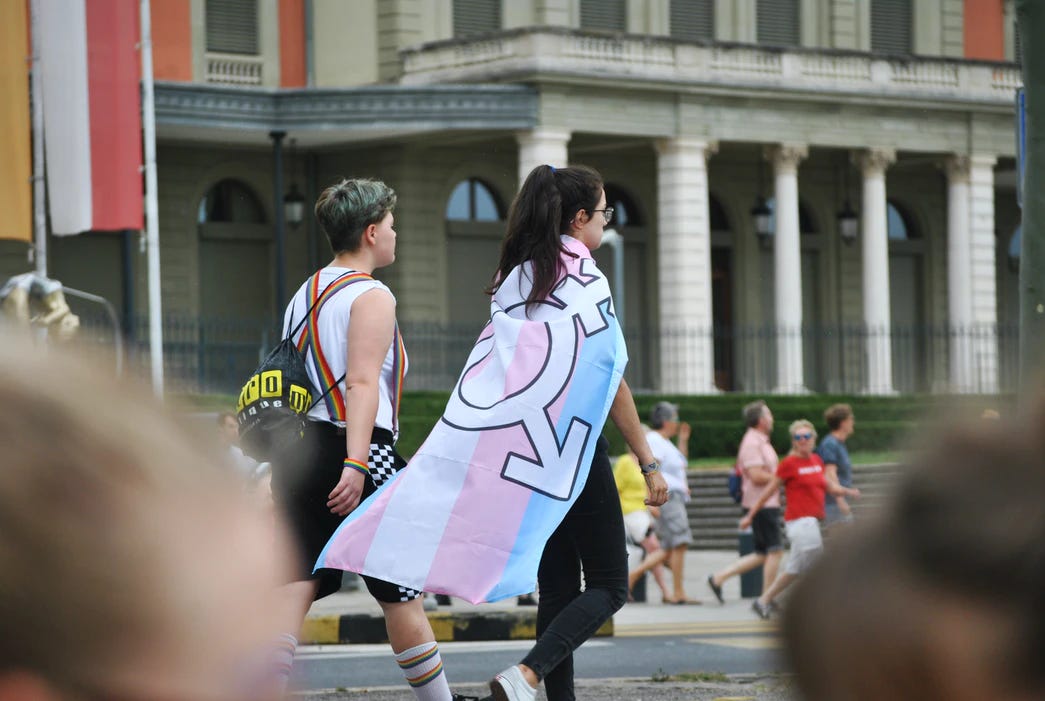
Questions? Comments? Requests that we dry off from our latest dip into the Seas of Gender and move on to other subjects? I’m at singalminded@gmail.com or on Twitter at @jessesingal. The lead image is from Geneva’s 2019 Pride parade, via Delia Giandeini on Unsplash.
Hi Jesse, I’m a recent subscriber. I signed up because I think I see the world pretty differently from you, but I still find your insights interesting and valuable (even when I don’t agree with them 100%; maybe even especially when I don’t).
I just want to say, as someone who considers myself very gender progressive (for lack of a better term), and have struggled a bit with my own gender identity, that some of the problems you identify can hurt trans and nonbinary folks too. I doubt I could say this in a more progressive/“woke” space without people getting mad at me, but the lack of a coherent philosophy of gender makes it really hard to resolve your own gender issues. I’m biologically a man (and feel comfortable saying that) but have never felt super comfortable with a male identity…whatever that means. I don’t love being perceived as a man, and I feel more comfortable when I’m consciously choosing to express myself with more of a mixture of masculinity and femininity than most men like doing.
So does that make me nonbinary? That’s what I’ve been trying to figure out. But to figure out if I’m “really” a man or “really” nonbinary, you really do first need a definition of gender. And the lack of a coherent one means I’m in this weird place where I’m like…am I just confusing myself, or is there actually a there there? And the only answer I get is stuff like “you’re nonbinary if you say you are.” To which the obvious response: “well, how do I know if I should say I am?” has no answer.
(I’m sure a lot of commentators here will feel like, “you’re a man, get over it,” and fine, that’s your opinion on the topic, but it’s also not really relevant to the point I’m trying to make here about progressive gender norms sometimes making gender exploration and expression, the ostensible goal of such progressive norms, harder rather than easier!)
I think your discussion on pronouns is also right on; the reason to use the pronouns someone asks you to use is just about respect, in my opinion; it’s no different from calling them the name they ask you to call them. But with names, if you forget that your coworker “James” actually goes by “Jim,” no one thinks you’re making a claim about their internal identity the way mistaking someone’s pronouns is seen as doing. And to go from pronouns-as-respect to weighing down these words with so much importance and meaning that people’s mental health can be afflicted is, I think, a mistake that progressive gender politics will eventually come to regret. (Now, of course, if I *intentionally* refer to Jim as James after he’s asked me not to, then I’m just an asshole. But is Jim going to feel like I’m invalidating his whole identity, or just that I’m an asshole?)
One nitpick though: you say that among the gender-woke folks (again, for lack of a better phrase), a common attitude is: “You see how someone dresses, and that tells you which gender they identify with — it’s a marker of a choice made in something of a free gender-market.”
But I’ve spent enough time with gender-woke people to feel confident in arguing that no gender-woke person would ever say that and, in fact, would say the exact opposite. The standard line is more like “it doesn’t matter at all what you’re wearing on the outside, gender is about what’s on the inside. So you can be a man and wear a dress, or a woman and dress androgynously, or nonbinary and present as entirely masculine, or whatever.” I think you see a lot of trans and nonbinary people who *do* express their identities through clothing choices, but in the same way that you might express yourself through the art you make, for example. Unless I’m misunderstanding your point, it seems to me like the actual woke line is almost exactly the opposite of what you said. (Now, whether the woke line and the actual woke practice are two different things would be an interesting point of discussion, though I don’t think so. If I show up to a woke space wearing a dress and tell everyone that, despite wearing a dress, I’m still a man, everyone there is going to accept that. I’d say that’s actually pretty key to woke gender norms, actually.)
This: "We’re (fe)male because of the body we have, and we are (wo)men because that’s what society calls people like us. There is no sense in which if someone called me a woman I would view it as some sort of deep violation of my innermost self — I’d just view it as incorrect, or ignorant if it were hurled as a knock on my behavior or manliness or whatever. So if Paige believed themself to be “like Jesse Singal” during their male moments, I’d just shrug and say “Are you?” I don’t think there’s any way to prove that’s true, which is all the more reason I’d need a better understanding for why it’s so vitally important that there is never even a fleeting moment of mismatch between Paige’s identity and the pronouns to which they are subjected." As a woman I feel exactly this way -- I have no sense of being a woman that is separate from my body and so I don't know what a trans woman says when she says she feels like a woman. I am more than happy to use female pronouns for her and welcome her into sex segregated spaces, but when it comes to something like choosing a physician, I would be much more comfortable with a trans man than a trans woman because I prefer a physician who knows what it feels like to live with a uterus and all that comes with it. I am more than happy to accept that there are other views of gender but I don't understand why one would trump another and the ways in which that is dressed up as some kind of scientific consensus based on a biological phenomenon when we actually know almost nothing about the biology of gender dysphoria is weird and does indeed feel like religion. But I have a trans son and it is impossible to have these conversations for more than a minute or two because all he feels is that the person who is supposed to see him and understand him the best cannot do so and that is too much for him to bear (surely in part because he has serious mental health challenges distinct from his dysphoria). I noticed that both of the trans women that Andrew Sullivan had on were reluctant to go down this road because they considered it philosophy. And I find it frustrating that people dismiss GCFs as TERFs because they are really trying to get at some of this in a way that deserves discussion, even if there is often a lot of unnecessary cruelty mixed in that completely undermines the argument.