

Modern artificial intelligence technology seems to already be having a major impact on at least one sector of the labor market: software development. Because AI systems are now — at least by certain measures — better and quicker coder than humans, company after company after company have announced significant layoffs. People who have trained their entire lives to develop software for a living are publicly expressing panic and existential dread. More anecdotally, I recently met someone who works at one of the giants out here in the Bay and she told me her employer explicitly told her that due to the new tools available, they expected her to increase her productivity by a specific, set multiple. (I asked her if the company could actually track her productivity with that much precision and she shrugged and said, Sorta.)
I believe AI is going to have a major disruptive impact for these reasons, but also because of my own experiences. I use AI every day as an utterly fascinated but also skeptical user. I’m utterly fascinated because, while I am not a Tech Guy, I’ve been using computers for three and a half decades — I was fascinated with computers as soon as I was first exposed to them, which led to my parents buying me a 386 — and am intimately familiar with the sorts of tasks they’re good at versus bad at. There has been an explosion in AI’s ability to do stuff it used to be bad at. Recently I had Claude make a PowerPoint and a simple JavaScript application, both for live shows, and it was simply insane: Of course there were minor rough spots, but the experience was indistinguishable from hiring someone for those tasks, going back and forth via email over edits and revisions, and so on. These are not super fancy design or software development tasks, but they are tasks I would have had to previously pay for or mooch off a friend for. If it is replacing human labor for those sorts of tasks, how could it not be replacing somewhat more advanced tasks? Of course it is. Hence the layoffs.
But I’ve been far more influenced and blown away by my normal, daily use of AI. At this point I use AI — mostly Claude — as something of an extra research assistant and set of “eyes.” It can quickly pull together a summary of some controversy, and as long as I follow long-ingrained Wikipedia Rules (take the text itself with a grain of salt and focus more on the sources it provides), it’s exceptionally useful. I also use Claude as an extra set of “eyes,” in the sense that if I input a draft of something I’m working on I can get perfectly competent — and steadily improving — editorial feedback. That doesn’t mean it’s perfect. In fact, if someone with almost no experience writing or reporting drafted a 1,200-word column and then trusted Claude to do the brunt of the legwork cleaning it up, I think the results could be potentially disastrous. In much the same way I read a human editor’s suggestions in an open-minded but skeptical way, that’s how I treat Claude’s. Sometimes I agree with the suggested edits and sometimes I don’t, and it is largely useful to me because I have a lot of experience writing and editing and can distinguish good from foolhardy feedback.
Overall, though, I am shocked at how good it is. Whereas with software development I am taking experts at their word, here I’m not: I have been doing this (writing and editing) for a long time. I have had good editors and bad editors. Claude is a pretty good editor that is effectively free ($20/month for the version I use) and that can read a 1,200-word draft and provide generally good, generally incisive feedback in about four seconds. Anyone who doesn’t think this is revolutionary technology is either being intentionally obtuse or lacks the sort of expertise required to render this judgment in the first place.
It strikes me as undeniably true that AI is going to eat a lot of jobs. I don’t think you need to be a labor economist to realize this — I think you just have to have a lot of experience using it and knowing about the sorts of tasks it is getting better at.
An analogy: Imagine, somehow, you’ve never seen a car smaller than a bus and you travel regularly between San Francisco and Los Angeles. You are at the whim of airlines and buses and the patchy rail service in this corridor. One day you find out about cars. You also find out that while cars are pretty expensive, they’re cheap enough that most adult Americans can afford to at least buy a used one.
You: Wait a minute. . . a machine that whisks you wherever you want, when you want, along any route with roads, at a relatively high speed? Why didn’t anyone tell me about this? Isn’t this going to revolutionize everything?
Smug, skeptical friend: Ummm, not so fast. Are you really qualified to say that when you aren’t a transportation or urban planning expert?
At a certain point, a new invention is so obviously, indisputably useful — that’s the only claim I’m making, useful — that it requires sticking your head deep into the sand to deny that it is going to have a major impact on society.
Unfortunately, there’s a fair bit about that going on. And it’s centered on the left, which is where we’re going to need the strongest, smartest critiques of AI. After all, these technologies are owned by unfathomably huge, juggernaut corporations. Those unfathomably huge, juggernaut corporations are already getting in bed with unfathomably huge, powerful governments (you may have seen that there’s been a bit of news on this front lately), and all of this is going to raise fundamental questions about fairness, what governments owe their people, and social welfare in general. That is, questions that the left is supposed to be concerned with.
It’s a really bad time for lefty thinkers to be asleep on the job, in other words.
Speaking of Which
I’ll get to a specific, high-profile example in a minute, but broadly speaking, lefty social-media discourse on AI involves a huge amount of abstract philosophizing. You’ll see sweeping claims that AI can’t do this or that — usually that it can’t “think” or “reason.” These are profoundly interesting debates if you’re a philosopher and profoundly boring debates if you’re interested in AI’s real-world impact on society.
I don’t even know how to find anything useful in the claim that Claude can’t think or can’t reason when I send it a draft of something I’m working on. I understand what’s being claimed — that the process by which Claude generates its output differs, in key ways, from the process by which a human editor would read a draft and generate his or her suggestions. But this doesn’t really matter. Either the end user finds the service useful in this context, or they don’t, and it is wildly useful. If you’re offended or think I’m anthropomorphizing, I’ll use scare quotes to soften the blow. Claude can clearly “read” and “understand” and “critique” and “evaluate” and “edit” and “offer suggestions to improve” anything I draft. For each of these terms, just swap “simulate the responses of a competent human reader.”
If you were a philosopher of mind and we were at a bar with several empty pint glasses before us, I’d have a ton of questions for you about all of this. It would be a super interesting conversation about the very nature of thinking and writing and communicating. But you’re not a philosopher of mind (well, most of you aren’t) and we’re not at a bar. It’s Monday at noon and I’m at my desk, writing, and I have a ton of work to do and, as always, I could use some extra help. Claude is extremely helpful. I still rely on and in many ways prefer human help — I continue to employ a wonderful human copy editor and am about to hire a human researcher — but Claude is extremely helpful.
There will be losers in all of this. A lot of them. I think my own jobs are fairly down the list of threatened ones, but I could be quickly and disastrously proven wrong about that. So what smart lefty thinkers should be doing now — to the extent they can influence the situation at all — is figuring out how to prevent this technological revolution from immiserating the people left behind.
Instead, there’s a disproportionate amount of moralizing and philosophical “bullshit” — I call it bullshit not because the underlying debates are uninteresting, but because they don’t matter if the end user finds the product useful.
There was a long conversation on this subject I found particularly telling (and vexing). It was on the journalist Robert Wright’s podcast/show NonZero. He interviewed Alex Hanna and Emily Bender, co-authors of The AI Con: How to Fight Big Tech’s Hype and Create the Future We Want, which came out last year. Hanna and Bender are both celebrated scholars on this subject. Bender co-authored the famous 2021 “stochastic parrots” paper, which is overdue for an in-depth revisit.
I have not read their book. I trust Bentham’s Bulldog, I read his review, and unless I plan on writing about The AI Con further, I’m probably not going to read it, to be honest. I think it’s perfectly fair to judge a pair of celebrated academics on the basis of how they present themselves during an hourlong interview podcast. And they — particularly Bender — came across as condescending, pedantic, and bizarrely out of touch with the on-the-ground reality of AI, given that this is supposedly their area of expertise.
Let me try to lay out their argument as faithfully as possible. Early on, Bender criticizes “this idea that AI is a thing, it’s inevitable, it’s imminent,” and contrasts it with her and Hanna’s “concerns not about anything AI would do but about what’s being done in the name of artificial intelligence as people try to chase this fantasy, the harms that are happening to actual people and the planet.”
Here and there, Bender and Hanna allow that AI is good at this or that task, but mostly they focus on the idea that the entire concept is itself incoherent, a con, or both. There is, of course, AI hype, and it can be hard for nonexperts such as myself to mistake hype from reality. But every transformative piece of technology also brings with it hypesters and fraudsters, and the existence of hype, even a lot of it, doesn’t mean much on its own.
Hanna and Bender don’t really think AI can “do” anything (I’ll return to that soon). They also don’t even seem to like using the term AI as one unified concept. They have lots of preferences about subtle matters of word choice in general. One of the stranger and more annoying exchanges occurs when, after Wright asks, “So where do you think it’s helpful?” Bender responds, “What do you mean by it?” Wright, who elsewhere in the interview exhibits clear familiarity with the underlying technology, does respond a bit tautologically, but this is sort of a silly question in context: By it he just means tools like ChatGPT, Claude, and so on!
Hanna then allows that something like ChatGPT might be useful for an independent journalist like Wright that “an LLM may be useful in so far as structuring your blog posts and then doing the verification after that to ensure that everything is in accordance with what you would want to say.” Wright tries to interject to clarify that he doesn’t use it to structure his posts (I don’t either, and I actually don’t think the vast majority of professional writers would), mentions that he might sometimes use it to “verify” something, and then Bender breaks in, “Wait, you’re using ChatGPT to verify something?”
Wright: Well, I’m more inclined to use Perplexity because it includes links, but I would say all of them are more and more inclined to include actual links to sources. But actually, not just verification. The most valuable thing is actually the research phase, and ultimately, you can use it to find the actual sources. And so, yeah—
Bender: So I’m saying, do you always go back to the actual sources? Or do you ever take just what comes out of Perplexity?
Wright: I go back to the sources if I’m going to report a fact or a quote or something like that, yeah.
Bender: Yeah, okay, good, because I was gonna say otherwise, you’re not doing journalism if you are not going back to the original sources, because these things make paper-mache out of their input. And yes, sometimes a link comes out, and it might be an effective way to get to that link for you, but — so you’re talking about the use case of basically a search engine. It’s a search engine that allows you to use more natural language rather than keywords. It’s a search engine that maybe does an end-run around some of the enshittification of search, right?
What jumped out at me, in relistening to this segment, is that Bender and Hanna don’t seem particularly interested in actually letting Wright explain exactly how he uses AI. On the one hand, fair enough — they are the guests and he is the host. But they just sort of put a lot of words in his mouth. Bender latches on to this idea that he is basically using it “as a search engine,” which seems like a real oversimplification of what Wright is saying. Then she explains that using it as a search engine is not a good idea.
Maybe I’m projecting, but I think Wright starts to sound a little worn down by this point:
Wright: I’m curious: Why is it not a good idea?
Bender: So most people who use a chatbot as a search engine are not going to actually use [it] as a search engine. They’re going to use it as an answer engine. They’re not going to drill down and look at the sources, and so they’re not going to see how those answers are located in the information ecosystem and how the sources speak to each other. As a trained journalist, I’m willing to believe that you are above that, and that you always go to the source, but the average user doesn’t. And then on top of that, you’re talking about systems that are environmentally ruinous. You’re talking about systems that are built on labor exploitation, and you’re talking about systems that are built on data theft. So to the extent that you are getting value out of that, compared to the old-fashioned search engine, compared to connecting with people and asking questions, that value is coming, not for free and not for whatever your monthly fee is, but actually at a very large cost to society.
I am not an expert on the power question, but just so that you are all aware that there is another side to this argument, here’s what Bentham’s Bulldog says in his review:
The authors then complain about the climate impacts of AI. They do this mostly by just citing the raw amount of energy used, and comparing it to other things. But it’s not surprising that a technology used by billions of people uses lots of power. If you prompt an AI 100 times, that will use about .1% of your daily power use. Compared to other activities we perform regularly, like driving, AI uses relatively little power (see here for more). Predictably, they also repeat the even more bogus water use canard — eating a single hamburger is over a million times worse for water usage than prompting AI.
I have not checked these statistics. I will say that I am biased, because I am supremely skeptical of the idea that using an LLM brings with it “a very large cost to society” that I should care about, relatively speaking. That is, as someone who sometimes drives a car when I don’t, strictly speaking, “have to,” and who consumes dairy on the regular, and who probably — okay, definitely — has food delivered to me more than I should — the idea that it’s my chatbot usage I should feel bad about. . . it just doesn’t pass the smell test.
That’s especially true when you at least recognize the possibility of chatbots saving energy over nearby alternatives. Compare two situations: A 2022 (that is, pre–powerful-chatbots) Google search for “reasons for end of Roman Empire,” which will entail a ton of follow-up clicks and searches, versus what I just did, which is prompt Claude: “Could you write up two thoroughly cited paragraphs reflecting contemporary thinking on the reasons the Roman Empire fell? Do this in a way that will be useful for someone like me who is a total novice to the subject and wants to dive into the existing literature.” I’ll stick the output in a footnote1, but I’d argue we should at least consider the possibility that this is a more energy-efficient way of getting the user that basic rundown and initial list of links than the technology we had four years ago.
I didn’t pick that example at random:
Wright: I mean, what I’ve found valuable is, if there’s something I just know nothing about — I mean, like, theories about why Rome fell or something — I find it a much more efficient way to just get a sense for the landscape, because, you know, it’s like having an actual expert that you can interrogate, and—
Bender [like Hanna, shaking her head vigorously]: No, no, there’s no expert there, and you’re not getting a sense of the landscape.
Wright: I don’t know — it’s closer than any other option I have. I definitely can’t summon—
Bender: Oh, go to the library! Talk to a librarian!
Wright: Yeah, but it’s so much slower! It’s so much slower!
Bender: Oh dear, you have to go out in the world and talk to people, like, you’re missing out on so much there, and on top of that you’re getting a fake view of a fake landscape.
This is such a striking and revealing exchange.
First, while I have nothing against libraries or librarians, and in fact quite like working in libraries, it is ridiculous, in 2026, to tell someone in this hypothetical situation to start with a librarian. If I ask a librarian for information about why the Roman Empire fell, s/he will either query the library’s catalog for certain keywords, or Google the question. The prior option will mean I’m at the mercy of that particular library’s collection of Rome-related materials, while the latter will just bring us back to algorithms and, increasingly, AI (given that that’s what pops up at the top if you Google something these days). And yes, as Wright indicates, that is a much slower process.
I’m not sure what Bender means by “fake view of a fake landscape.” If she’s talking about the possibility of hallucinations, that’s a problem, for sure, but 1) less and less so with each new model, and 2) a problem you can avoid by maintaining Wikipedia reader–level savviness and double-checking any specific claim you see in the text. If she’s talking about bias in a broader sense — that is, the literature itself is biased in favor of some explanation for Rome’s fall — then how would a librarian magically overcome that bias? I’m confused and wish Wright had pressed her on this (in his defense, there was a lot of cross-talk at that moment and at this point they had hit the hour mark).
Knowing Without Using
I think Bender and Hanna, and particularly Bender, really hate this technology. They aren’t shy about it and that’s probably the neatest explanation for how you can get to the point where, with a straight face, you’re advising a professional journalist to seek a librarian’s help getting started on a research project in 2026. One key fact is buried deep in the interview and actually comes right before the Rome exchange, after Bender allows that in certain specific cases, she does think LLMs engage in “understanding”:
Bender: But the problem is, it’s all dressed up in all of this other fluff, which plays on my ability to make sense of language and makes it seem like it’s not just a machine that has been able to map what I said to some specific routine to carry out, but rather some thinking entity that has any right to use I/me pronouns that I’m interacting with.
Wright: Mm-hmmm. You know, I was going to ask you this question. You said you never go to ChatGPT. Do you not use the chatbots, the LLMs yourselves in your lives—
Bender: None of them.
Wright: —and if you do use them, how do you use them? But do you not use them at all?
Bender: I do my very best to avoid reading any synthetic text or consuming any synthetic media. I am not interested in reading something that nobody said, that nobody wrote.
Hanna: I just check how bad they are at things. [Hanna then explains that she keeps hearing it’s good at coding but remains unconvinced.]
I’m confused how Bender can make such confident claims about LLMs — especially her lack of concern that they will actually take jobs — when she makes a point of not using them. This might explain why my trajectory has been the opposite of hers. The more I use LLMs, the more impressed I am, the more useful I find them, and the more worried I am about their economic and more general societal impact. Why can’t we hold all those ideas in our head at the same time?
At the opposite end of Hanna and Bender is the New Yorker’s Gideon Lewis-Kraus, who wrote a fantastic article about Anthropic’s attempts to understand this strange entity it has built, Claude. He then went on PJ Vogt’s podcast Search Engine to talk about his piece.
One part at the end continues to jump out at me, especially after having listened to the NonZero interview multiple times. “I think people wanna have one feeling about this stuff,” he explains at around 44:45. “They wanna be angry about it, or they wanna be messianic about it.” But in the course of reporting on this story, Lewis-Kraus gave up on the idea that there’s any one way people should feel about AI — he just thinks the technology is too big and consequential for that to be the correct approach. “We have this unprecedented entity that is the only other thing besides us that can talk,” he explains. And “There’s nothing that it doesn’t touch on.”
In context, by talk Lewis-Kraus means engage in an intelligent, sustained conversation. And he’s right! Humans have created a type of software that you can talk to for hours. It’s incredible. It’s going to have all sorts of effects — it’s not easily boiled down to any one outcome. It definitely can’t be written off the way certain people are doing.
In the Search Engine episode, Vogt then explains that contrary to certain negative stereotypes of techbros, according to Lewis-Kraus’s reporting, the folks actually paid to work on these issues at places like Anthropic care deeply about the impact this technology will have on society. But “our intellectual culture is really bad right now”and they are “looking for grown-ups and not really finding people to have a conversation with.”
Lewis-Kraus responds:
And we are playing a role in that too. Every time someone on our side, so to speak, is just like this is all a parlor trick, this is all hype, this is all smoke and mirrors, we are abdicating our own responsibility to be involved in this. . . . Of course [hypesters] exist and of course all of those people are part of this system too, but there are others who want partners and talking about this stuff, and that means that we all need to try to rise to the occasion.
Maybe I’ll close with one other analogy: capitalism. Critics of capitalism can be roughly divided into those who treat it as a fundamentally evil force that destroys everything, full stop, not much more to say, like seriously fuck capitalism, and those who, even if they are harshly critical of it, acknowledge the obvious reality: Capitalism also has upsides and convenience for a lot of people.
Who do you trust to produce better thinking and more tenable solutions to the problems that capitalism, whatever you think about it, does inevitably produce? Which type of critic is better equipped to offer the right sorts of laws and regulations and norms?
There’s something similar going on here. You can be the sort of person who parrots lines about. . . well, parrots, who insists that an in-fact revolutionary and deeply fascinating technology is a parlor trick, who isn’t particularly interested in how normal everyday people use this technology. You can avoid using it entirely yourself because you don’t like the stink of it. You can scoff and condescend and, in the long run, ghettoize yourself out of the conversation.
Or you can recognize what’s really going on and how desperately in need of adult conversations and adult solutions we are. If not now, then very, very soon.
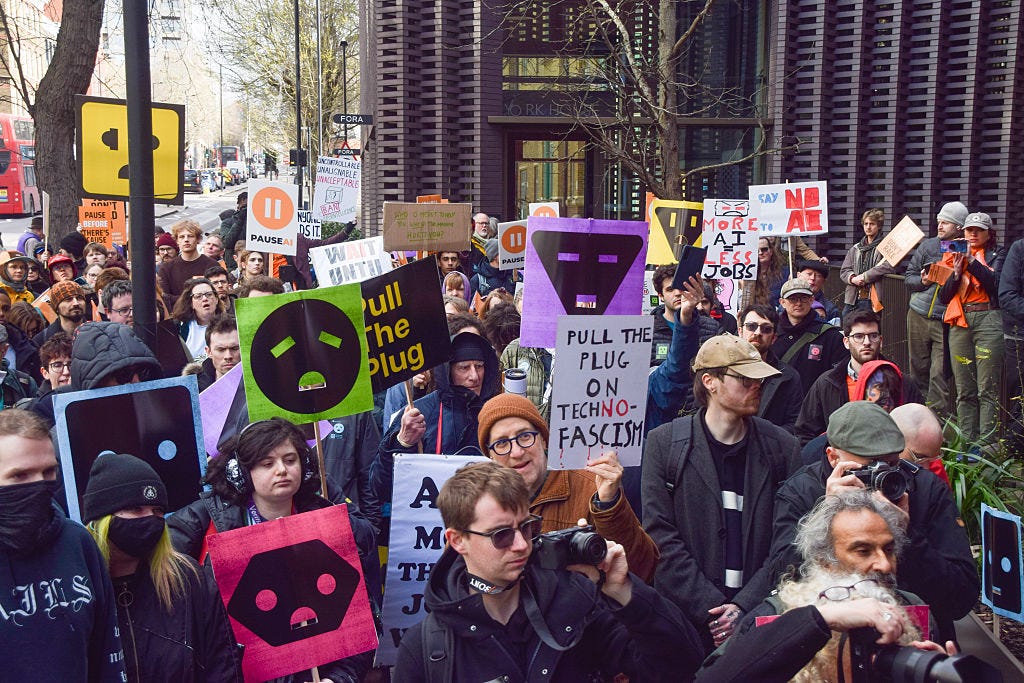
Questions? Comments? Responses to the rumor that I once dated an LLM for six months without realizing it? I’m at singalminded@gmail.com. Image: LONDON, UNITED KINGDOM - 2026/02/28: Protesters gather with anti-AI placards outside OpenAI offices in King's Cross during a march against unregulated Artificial Intelligence (AI) and data centres. (Photo by Vuk Valcic/SOPA Images/LightRocket via Getty Images)
Claude responded:
Here are two substantive, cited paragraphs on contemporary thinking about Rome’s fall, along with pointers into the literature for a new reader:
The most important thing to understand going in is that modern historians have largely abandoned the search for a single cause. Historians generally classify explanations into two broad schools — external factors such as barbarian invasions, and internal factors such as declining civic virtue and economic capability — but most believe the fall resulted from a combination of both, while recent scholarship has added climate change, epidemic disease, and environmental degradation to the mix. [Wikipedia] The most influential recent entry in this debate is Kyle Harper’s The Fate of Rome: Climate, Disease, and the End of an Empire (Princeton University Press, 2017), which makes a sweeping argument that nature itself was a principal actor. Harper traces how the fate of Rome was decided not just by emperors, soldiers, and barbarians but also by volcanic eruptions, solar cycles, climate instability, and devastating viruses and bacteria, taking readers from Rome’s pinnacle in the second century to its unraveling by the seventh. [Princeton University Press] Specifically, there was a Roman climatic optimum from about 200 BCE to 150 CE, when lands around the Mediterranean were generally warm and well-watered, making agriculture prosperous, army recruitment easy, and tax collection straightforward [Wikipedia] — conditions that then deteriorated badly. Three successive plagues compounded the damage: the second-century Antonine Plague (likely smallpox), the third-century Plague of Cyprian (a hemorrhagic fever possibly related to Ebola), and the sixth-century Plague of Justinian, confirmed through DNA testing of burial sites to have been bubonic plague, each killing millions and steadily stripping the empire of its reserves of people and productivity. [Concerning History] Harper’s thesis has attracted both admiration and pushback from specialists, with critics noting that he sometimes overstates nature’s deterministic role, but his core insight — that environmental and biological forces dramatically narrowed the margin for political error — is now widely accepted as an essential part of the picture.
The political and military dimensions of the collapse remain just as hotly debated. Peter Heather’s The Fall of the Roman Empire: A New History of Rome and the Barbarians (Oxford University Press, 2006) and Bryan Ward-Perkins’s The Fall of Rome and the End of Civilization (Oxford University Press, 2005) represent a forceful counter to scholars who downplay the violence of the end. Rome had tangled with Germanic tribes for centuries, but by the 300s groups like the Goths had encroached beyond the empire’s borders; in 410 the Visigoth King Alaric sacked Rome, the empire spent the next decades under constant external threat, and in 476 the Germanic leader Odoacer deposed Emperor Romulus Augustulus — the event traditionally taken as Rome’s death blow. [HISTORY] Internally, constant wars and overspending had significantly depleted imperial finances, oppressive taxation and inflation widened the gap between rich and poor, and the empire was undermined by a labor deficit as its slave-dependent economy lost access to fresh conquered peoples. [HISTORY] A third camp, associated with the historian Peter Brown and his concept of “Late Antiquity,” resists the language of catastrophe altogether: some historians argue that the Roman Empire did not fall at all, but that the “decline” was instead a gradual, often violent, transformation into the societies of the Middle Ages. [Wikipedia] For a newcomer, the most useful path into the literature is probably to read Ward-Perkins (short, empirical, and accessible) alongside Harper, since together they cover the two great axes of current debate — external shock versus environmental collapse — before moving on to Heather for political narrative depth or Brown’s The World of Late Antiquity for the cultural transformation perspective.
Right after the recent Supreme Court decision on tariffs, I was listening to a legal podcast to learn about the case in more detail. It's a show tailored to lawyers, which I am not, so they don't always define the technical terms they're using. It quickly became clear that "the non-delegation doctrine" was a key concept in the case. I knew that I had heard the term before, but I didn't know what it was well enough to follow the conversation. So I paused the podcast, opened Gemini, tapped the microphone button, and said, "Give me a one-paragraph explanation of the non-delegation doctrine." One minute later, I understood it well enough to resume the podcast and learn how that doctrine influenced the conflicting opinions in the tariffs case.
The idea that the *right* way to approach that situation was to stop the podcast, stop the house cleaning that I was doing while I listened, get in my car, drive to the library 4 miles away, and either ask the reference librarian or try to figure out which book to look in for an explanation--well, that's just delusional. Mine was a kind of question on which there is virtually no chance that the answer will be hallucinated or fundamentally wrong. (I also use LLMs for deep research in technical questions, and there the risk of hallucinations is non-trivial; where they cannot find a clear answer, they're prone to inventing one. But when something is widely discussed in hundreds of reliable, easily accessible sources, like judicial doctrines, LLMs are very unlikely to give wrong information.)
As Jesse says, LLM are just supremely *useful* in a way that can only be denied by those who haven't tried them--or who, metaphorically, cover their ears and yell "I CAN'T HEAR YOU! I CAN'T HEAR YOU!"
Two more things:
1) for the AI water use and in general resource use, here: https://andymasley.substack.com/p/the-ai-water-issue-is-fake
the guy breaks down in extreme detail and with a lot of reliable sources the supposed problem of resource usage in AI, showing that is basically a bs.
2) when she says "No, no, there’s no expert there, and you’re not getting a sense of the landscape" you know that either she is wrong because she didn't even try the chatbots (weird for a person like her), or she's wrong because she has already decided that they are a con because this fits her ideology (anti-capitalist, de-growther, intersectional-some-bs-like-that). I work in ML, if you ask a chatbot about that particular ML topic, he will answer perfectly, even without searching the internet. A friend of mine that works in genetics could say the same, as well as other people knowledgeable about various subjects. In general, if the question and the argument are not extremely obscure, a modern LLM will get the answer 100% right, more so if it's a general question on a topic that is famous and interesting for the larger public (that is, what 99% of open-ended questions to ChatGPT will be). These chatbots were trained on like 85 billion books about the Roman Empire so yes, they will give a general answer that is absolutely correct, even without searching on the internet.
It's much more likely the librarian will give you more wrong answers about a certain list of topics compared to a chatbot.