

Here’s a fictional clip from the average documentary I’ve watched on Netflix over the last several years:
Officer Smith: So I’m looking at this faded photo of the missing girl, Sarah. . .
CUT TO: a shot of the photo in question slowly falling and rotating over a dark background featuring faint whiffs of smoke.
Officer Smith: . . . and I notice something odd. It just hits me like a thunderbolt.
CUT TO: B-roll of lightning
Officer Smith: I get up and I walk over to my boss’s desk. . .
CUT TO: B-roll of a knees-down shot of a police officer walking along a floor
Officer Smith: . . . and I say, “Sarge, have you noticed this green splotch on Sarah’s shirt in this photo?”
CUT TO: The Webster’s dictionary definition of that color, written in green on a black background:
“green
1 of 3
adjective ˈgrēn
1 : of the color green
2 a : covered by green growth or foliage green fields
b : consisting of green plants and usually edible herbage a green salad
c : of winter : mild, clement”
I’ll stop torturing you. The point is there’s been a tendency, at least within the documentaries I’ve watched, toward relentless over-explanation and over-signposting. I’m sure part of this is that many of these documentaries were two- and three-part miniseries that should have just been a single 80-minute documentary (like God intended), but that Netflix wanted to drag out for analytics purposes. But it’s hard not to connect it to the fact that we are (imagine me on a TED Talk stage wearing a too-tight turtleneck) Inundated With More Content Choices Than Ever Before — Choices That Undeniably Rob Us Of Our Ability To Focus.
So that was the first thing that jumped out at me about The Perfect Neighbor, the new documentary on Netflix directed and produced by the filmmaker Geeta Gandbhir, which is racing up all sorts of charts and generating a large amount of press (prior to that, it won a directing award at Sundance).
The Perfect Neighbor is the story of Susan Lorincz, a white Florida woman who in June of 2023 shot a black neighbor, Ajike “A.J.” Shantrell Owens, through a closed, locked door, killing her and sparking a controversy over Florida’s “stand your ground” laws.
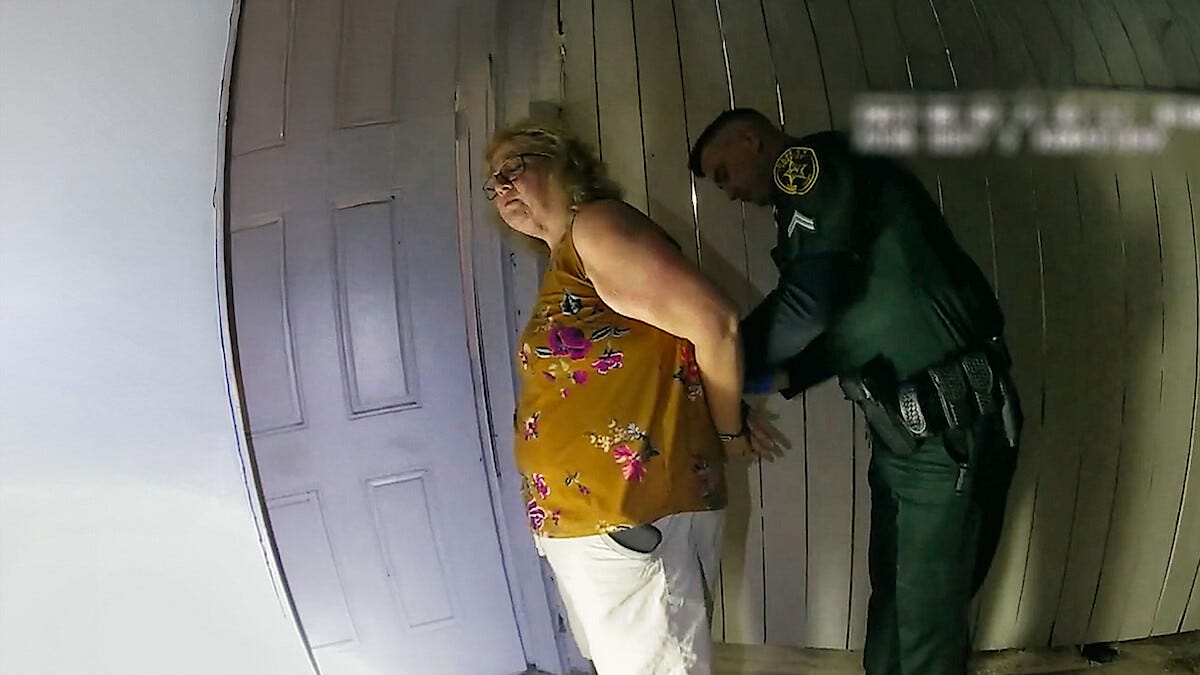
Early on, the film notes that the majority of its footage is pulled straight from police body cam footage. This allows the viewer to slip into a rhythm — sometimes it felt more like a trance — that demands a bit of attention. It’s not like those other documentaries, where the viewer barely has time to let a reaction form in their head before it’s on to the next jump-cut.
The “plot” is simple and mostly revolves around police visits to Lorincz. She can’t stop calling the cops on the local kids, who she regularly accuses of trespassing on her property and otherwise bothering her. As the body cam footage reveals, it’s one of those neighborhoods where the kids spend a lot of time outside running around, and where they and their parents all seem to know one another. The modest houses are mostly being rented, and Lorincz seems to be the only resident who finds the kids bothersome. There isn’t much evidence any of them actually trespass on her property, though the boundaries get a bit blurry given that her house abuts some space that is, thanks to the permission of the home/landowner, accessible to the kids, who play football and other games there.
So we’re treated to video after video with Lorincz, who comes across as disturbed and vindictive, insisting that she’s being wronged or harmed or threatened by her neighbors. The cops can’t seem to find anyone in the neighborhood who is on her side — rather, she has developed a reputation as that crazy lady who yells at everyone’s kids. (The fact that at one point, Lorincz gets locked into a parking lot and tries to ram her way out with her truck, damaging the gate in the process, rather than call the number posted there, doesn’t exactly enhance her credibility.)
The filmmakers don’t let Lorincz hog the spotlight: They also include lengthy stretches of the cops in question patiently talking things through with the kids and the parents, trying to be diplomatic. They repeatedly ask the kids to stay away from Lorincz’s house, but also tell them they’re not doing anything wrong by running around and playing. These sequences also give us a visceral sense of the neighborhood, painting a picture of a place that comes across as peaceful and close-knit (setting aside the kids running around and playing and screaming, as kids tend to do).
Here’s the paragraph I originally drafted about this film, before I read more about it, and which I’ll revisit shortly: I guess one could say The Perfect Neighbor has a bit of a “political agenda.” For reasons that will become clear if you watch the film, this actually isn’t one of those cases of demagogues simply assuming an interracial killing is motivated by race. Rather, there’s some evidence to support that conclusion. But the film devotes only a fraction of its runtime to covering the wave of local activism that swelled after Owens’ death (the Rev. Al Sharpton makes an appearance and delivers a pretty moving line at a church service) or to the racial politics of the killing. Wisely, perhaps because she recognized the absolute goldmine of footage she had in her possession, Geeta Gandbhir instead leans on that footage to tell the story in as naturalistic a style as possible.
This includes an absolutely heartbreaking sequence that is very hard to watch. After the 911 call reporting Owens’ shooting, body cam footage shows us her children, other relatives, and friends reacting in real time first to her being shot and then, a bit later, to the news that she was dead.
I found myself torn about this: Was it overly voyeuristic? Emotionally manipulative, somehow? A couple of days later, I can understand its inclusion. It’s simply rare to be in possession of so much footage showing such a raw but universal human experience, and it wouldn’t make sense to tell this story without telling it in as unvarnished and painful a manner as possible.
To be fair, most documentarians don’t benefit from a goldmine of footage. When you realize that someone making a documentary needs to have something displayed on screen for every second of its runtime, you can understand why they might use cheesy reenactments or B-roll as a crutch. But I really appreciated The Perfect Neighbor’s confidence in letting this jarring story speak for itself, and I hope its success triggers some sort of zagging away from the overproduction and hand-holding that has become a ubiquitous feature of our attention-addled landscape; I hope it signals just how powerful the cinema verité style can be, despite the fact that our culture is racing in a very different direction.
On Ethics and Activism and Journalism
I started writing this piece knowing very little about the background of this film. Then I read more about it and. . . well, there’s a lot to discuss. Much of it is troubling.
